About Monetaria annulus (Linnaeus, 1758)
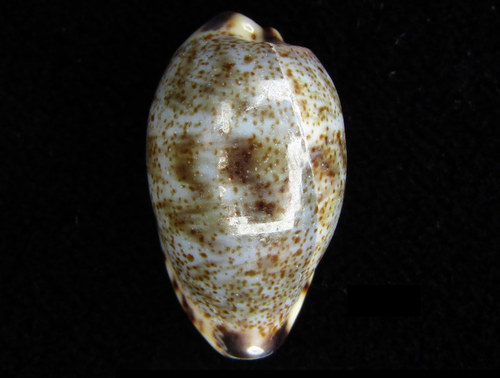
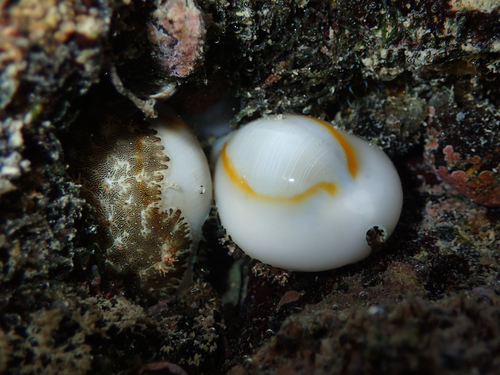
Monetaria annulus, commonly called the ring cowry, has a shell that ranges in size from 9 mm to 50 mm. The shell is mostly off-white or pale yellowish, sometimes with a dark tint on the upper dorsal surface. It displays two yellow or orange stripes along its upper sides; these stripes almost meet at both ends, creating the appearance of a ring that gives the species its common name. This species and its subspecies are distributed in the Red Sea, across the Indian Ocean along the coasts of Aldabra, Chagos, the Comores, the East Coast of South Africa, Kenya, Tanzania, Madagascar, the Mascarene Basin, Mauritius, Mozambique, Réunion, the Seychelles, Somalia, Yemen, Oman, the Maldives, India, and Sri Lanka. It is also found in the tropical Pacific Ocean, ranging as far north as Hawaii and reaching the Galápagos islands in the western Pacific. The ring cowry was commonly used as shell money in parts of Asia, Africa and the Middle East, similarly to the related species Monetaria moneta. Occasionally, the distinct ring marking on the back of the shell was hammered off, making the modified shells almost indistinguishable from other money cowry species. Many shells of Monetaria annulus were recovered by Sir Austen Henry Layard during his excavations at Nimrud between 1845 and 1851. During and after the North American fur trade, European traders introduced this shell to Native Americans as a low-cost substitute for highly valued elk ivory. Native Americans used the shells for dowry, ornamentation, and other purposes.