About Moneilema semipunctatum LeConte, 1852
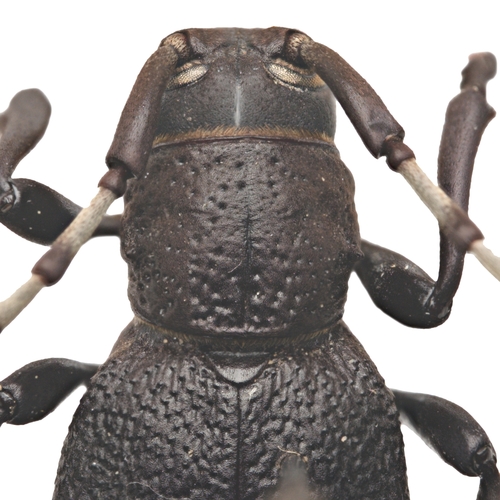
Moneilema semipunctatum, also called the cactus borer beetle, is a species of longhorn beetle in the family Cerambycidae. It was first described by John Lawrence LeConte in 1852. All beetles in the genus Moneilema are commonly known as cactus longhorn beetles. This species is native to North America, where it is found in the western United States and Mexico. This species has variable morphology. It is wingless, solid black, generally convex and elongated in shape, with a texture ranging from shiny to dull. It has no hair, and its body is marked with small puncture-like indentations. Adult females measure 1.5 to 3 centimeters in length, while adult males measure 1.5 to 2.6 centimeters. This beetle inhabits desert environments, where it feeds on cactus plants, particularly prickly pear (genus Opuntia) and cholla (genus Cylindropuntia) species. This beetle is a threat to multiple rare cactus species: these include the Mojave fishhook cactus (Sclerocactus polyancistrus), Wright's fishhook cactus (Sclerocactus wrightiae), Mesa Verde cactus (Sclerocactus mesae-verdae), Winkler's pincushion cactus (Pediocactus winkleri), and San Rafael cactus (Pediocactus despainii). Adult Moneilema semipunctatum are active at night or during twilight. They emerge and climb cactus plants at dusk to feed through the night. Mating also occurs at night, after which females lay eggs near the base of host cacti. The beetle larvae feed on the cactus plant, burrowing into its tissue and causing damage.