About Monasa nigrifrons (von Spix, 1824)
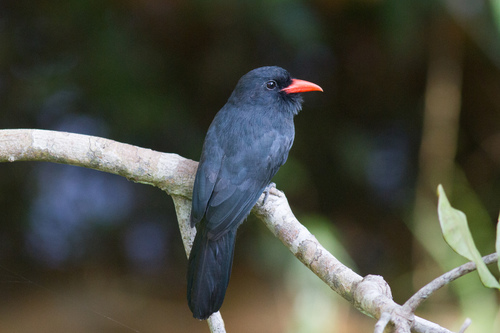
The black-fronted nunbird (scientific name Monasa nigrifrons (von Spix, 1824)) measures 26 to 29 cm (10 to 11 in) long and weighs 68 to 98 g (2.4 to 3.5 oz). Adult nominate subspecies individuals are mostly sooty black, with the darkest coloring around the bill, which forms the species' namesake 'front'. The rear of the body is blue-gray, and the tail is blue-black. The bill is red, the eye is dark, and the legs are black. Subspecies M. n. canescens is slightly paler and grayer than the nominate subspecies. Juveniles of both subspecies are dirty slate gray with irregular reddish marks.
For distribution and habitat, the nominate subspecies is widespread across the Amazon Basin, occurring in southeastern Colombia, eastern Ecuador, eastern Peru, and much of Brazil. In Brazil, it is found north of the Amazon as far east as the Rio Negro; south of the Amazon it ranges east to Pará and Alagoas states, and south to eastern Mato Grosso do Sul and western São Paulo states. Subspecies M. n. canescens is found only in eastern Bolivia. The black-fronted nunbird lives in a range of landscapes, but favors trees and bamboo along the margins of rivers and lakes. Its main forest habitats are várzea, igapó, and gallery forest. It also occurs in secondary forest, swampy river islands, transitional forest, and mid-succession to mature floodplain forest. Unlike many other nunbird species, it avoids terra firme forest. It occurs at elevations from sea level up to 1,000 m (3,300 ft).