About Monasa morphoeus (Hahn & Küster, 1823)
The white-fronted nunbird, scientific name Monasa morphoeus (Hahn & Küster, 1823), is 21 to 29 cm (8.3 to 11 in) long. Body weight varies by region: Central American individuals weigh 90 to 101 g (3.2 to 3.6 oz), those in the eastern Amazon weigh 77 to 87 g (2.7 to 3.1 oz), Venezuelan individuals weigh 63 to 80 g (2.2 to 2.8 oz), and Bolivian individuals weigh 80 to 84 g (2.8 to 3.0 oz).
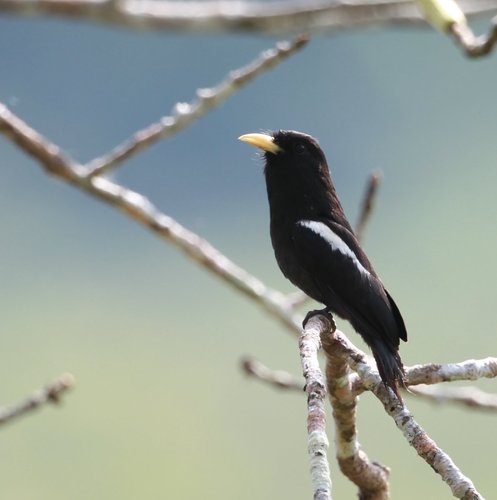
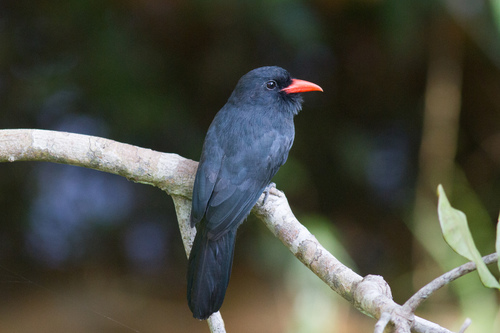
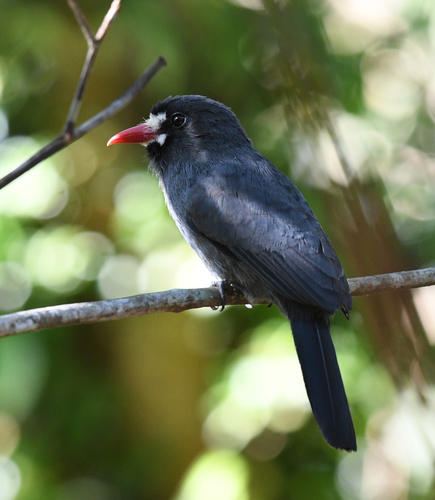
Adults of the nominate subspecies are mostly dark grayish black, with slightly grayer underparts. The forehead, or "front," and chin are white. The nominate adult has an orange-red bill, brown eyes, and black legs. Immature birds have a buffy-rufous face, and their body feathers have a brownish tinge and brownish edges.
Other subspecies of white-fronted nunbird differ from the nominate in body size, plumage darkness, and the extent of white markings on the face. Northern subspecies are larger than southern ones. M. m. sclateri has a black chin, little contrast between upperparts and underparts, and paler wing coverts than the nominate. M. m. pallescens is similar to M. m. sclateri but is paler overall, has more contrast between upper- and underparts, and has the largest forehead white patch of all subspecies. M. m. fidelis resembles M. m. pallescens but is slightly darker and has a whitish chin. M. m. grandior is slightly darker than M. m. fidelis and has little contrast between upper- and underparts. M. m. rikeri is slightly paler than the nominate, and M. m. peruana is even paler than M. m. rikeri.
The subspecies have the following distributions: M. m. grandior ranges from eastern Honduras and eastern Nicaragua through eastern Costa Rica into western Panama; M. m. fidelis is found on the Caribbean slope of eastern Panama and in northwestern Colombia as far east as Córdoba Department; M. m. pallescens occurs from southeastern Panama into western Colombia as far south as the upper San Juan River; M. m. sclateri is found in Colombia's Magdalena Valley, including the Serranía de las Quinchas, south to northern Tolima Department; M. m. peruana ranges across eastern Ecuador, southeastern Colombia, and southern Venezuela, south through eastern Peru into northeastern Bolivia, and east into Amazonian Brazil as far as the Tapajós River; M. m. rikeri occurs in Amazonian Brazil from the Tapajós River east to Maranhão state; M. m. morphoeus is found in coastal eastern Brazil from Bahia south to Rio de Janeiro state.
The white-fronted nunbird lives in a range of wooded landscapes, including lowland terra firme, rainforest, and gallery and transitional forest. It also occurs in more open environments, such as partly deforested areas, shaded cacao plantations, and abandoned clearings with scattered trees. Across most of its range, it occurs below 300 m (980 ft) elevation, but it reaches 750 m (2,500 ft) in Panama, 1,050 m (3,400 ft) in Peru, and locally 1,350 m (4,400 ft) in Ecuador.