About Monasa flavirostris Strickland, 1850
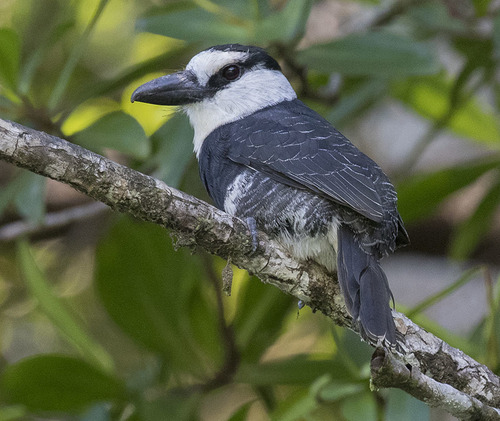
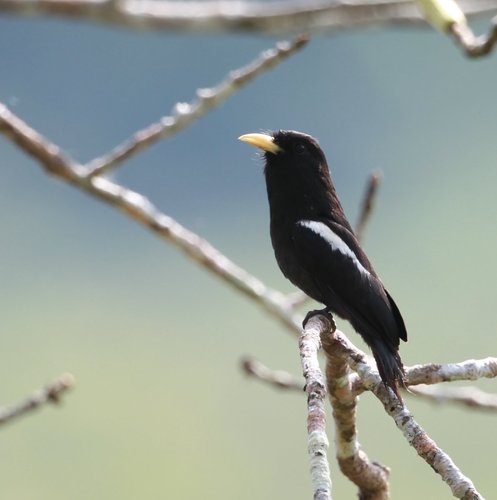
The yellow-billed nunbird (scientific name: Monasa flavirostris Strickland, 1850) measures 23 to 25 cm (9.1 to 9.8 in) in length and weighs approximately 39 g (1.4 oz). Adult individuals are mostly sooty black, with a belly that tends to very dark gray and a greenish black tail. Their lesser wing coverts are mostly white, and appear as white spots on the closed wing. The bill is yellow, and is noticeably shorter than the bills of other species in its genus. The eye is dark, and the feet are blackish. Immature yellow-billed nunbirds are a slightly duller black than adults, and their white areas are not as prominent. The yellow-billed nunbird is found in two separate areas of the upper Amazon Basin. One range extends from southeastern Colombia through eastern Ecuador into northern Peru. The second range includes eastern Peru, northern Bolivia, and western Brazil, reaching as far east as the upper Purus River. This species lives in somewhat open landscapes, including transitional forest, secondary forest, the edges of terra firme forest, and regenerating clearings with scattered trees. It occurs from the understory up to the subcanopy. In Colombia, it is typically found in the Andean foothills, at elevations up to 1,400 m (4,600 ft). In Ecuador, it locally reaches elevations as high as 750 m (2,500 ft), but usually occurs below 400 m (1,300 ft).