About Monarda fistulosa var. stipitatoglandulosa (Waterf.)
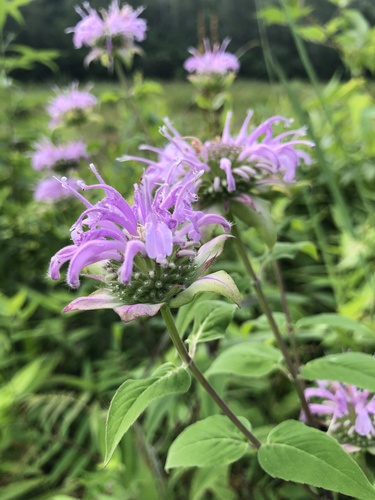
Monarda fistulosa, which includes the variety Monarda fistulosa var. stipitatoglandulosa (Waterf.), is an herbaceous perennial that grows from slender creeping rhizomes, so it commonly forms large clumps. Plants typically grow up to 3 feet (0.91 meters) tall, with a few erect branches. Its leaves are 2–3 inches (5.1–7.6 cm) long, lance-shaped, and toothed. Compact flower clusters grow singly at the ends of branches; each cluster is about 1.5 inches (3.8 cm) long and holds 20–50 flowers. Wild bergamot, the common name for this plant, often grows in rich, limy soil in dry fields, thickets, and clearings, and generally flowers from June to September. Its native range extends from Quebec to the Northwest Territories and British Columbia, south to Georgia, Texas, Arizona, Idaho, and northeastern Washington. The Latin specific epithet fistulosa means hollow like a pipe. The plant is known for its fragrance, but the composition of its essential oils varies considerably. It can contain thymol, geraniol, carvacrol, p-cymene, γ-terpinene, α-terpinene, and α-thujene in differing amounts; the exact cause of this variability is still under research, though both environmental and genetic factors are thought to contribute. At least one population in Colorado also contains linalool. In ecological terms, this is a honey plant popular with a wide range of pollinators, including bees, hummingbirds, and lepidoptera. It is a larval host plant for the hermit sphinx, orange mint moth, and raspberry pyrausta. Wild bergamot is considered a medicinal plant by many Native American peoples. The Oneida name it "Number Six", honoring it as the sixth medicine given by the Creator; other Indigenous groups that use the plant include the Menominee, Ojibwe, and Winnebago (Ho-Chunk). It is most commonly used to treat colds, and is often made into a tea. Many families still use wild bergamot during the cold and flu season today; the tea is often sweetened with honey because it has a very strong flavor. Along with other Monarda species that share the common name "bee balm", M. fistulosa has a long history of medicinal use by Native Americans, including the Blackfoot people. The Blackfoot recognized the plant's strong antiseptic properties, and used plant poultices to treat skin infections and minor wounds. A plant tea was also used to treat mouth and throat infections caused by dental caries and gingivitis. Bee balm is a natural source of the antiseptic thymol, which is the primary active ingredient in modern commercial mouthwash formulas. The Winnebago used bee balm tea as a general stimulant. Native Americans also used bee balm as a carminative herb to treat excessive flatulence. Its leaves were eaten boiled with meat, and a plant preparation was made into hair pomade. The herb is classified as an active diaphoretic, meaning it induces sweating. One analysis of Monarda fistulosa essential oil, done using mass spectrometry and arithmetical retention indices, found it contains p-cymene (32.5%), carvacrol (24.0%), thymol (12.6%), an aliphatic aldehyde (6.3%), the methyl ether of carvacrol (5.5%), α-pinene (3.5%), β-pinene (2.9%), sabinene hydrate (1.9%), α-terpinene (1.7%), citronellyl acetate (1.6%), and β-caryophyllene (1.1%). M. fistulosa distillate has been proposed as an antimicrobial agent for laboratory use, specifically as an additive to the artificial media used to grow tachinid fly larvae.