About Monarda bradburiana Beck
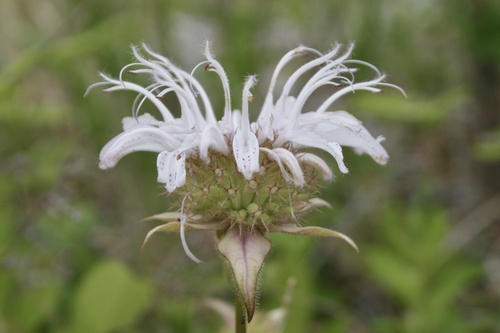
Monarda bradburiana Beck is a herbaceous perennial plant that reaches 1 to 2 feet (30 to 60 cm) in height. Its stems are scantily branched, square, and usually hairless, though new growth may occasionally have a small number of hairs along the stem angles. Leaves grow in opposite pairs, measuring around 3.5 inches (9 cm) long and 2 inches (5 cm) wide. They are shaped ovate or broadly lanceolate, with toothed margins. Lower leaves have short petioles, while upper leaves lie closely appressed against the stem. The upper surface of leaf blades is often pubescent, and ranges in color from yellowish-green to solid green; leaves may sometimes develop purple spotting or a purple tinge along the margin. The uppermost leaves develop into bracts that sit below the plant's blooms. Flowerheads are roughly 1.5 inches (4 cm) wide. They start out cone-shaped and flatten as they mature, with central florets opening first. Each floret has a tubular, hairy calyx with five pointed lobes. Florets are white or pink, curved, and around 1 inch (2.5 cm) long, with a narrow tube, narrow upper lip, and a slightly wider lower lip marked with purple speckles. Flowering typically occurs in late spring and early summer. The plant produces seed in the form of nutlets that can be dispersed by wind, and it can also spread vegetatively via growth from rhizomes. Monarda bradburiana is native to the central and southeastern United States, where it occurs in the states of Alabama, Arkansas, Iowa, Illinois, Indiana, Kansas, Kentucky, Louisiana, Missouri, Oklahoma, Tennessee and Texas. Its typical habitat includes thickets, woodland edges, grassland and roadsides. The flowers of Monarda bradburiana produce large amounts of nectar, and attract bumblebees, other long-tongued bees, butterflies, hummingbird moths, beeflies and hummingbirds. Halictid bees, which cannot reach the plant's nectar, harvest pollen from it instead. A specialist pollinator of this species is Doufourea monardae, a small black bee. Monarda bradburiana is a food plant for caterpillars of the hermit sphinx, the gray marvel, the orange mint moth and the raspberry pyrausta moth. Herbivorous mammals generally avoid eating the plant's foliage, likely because it produces an oregano-like odor.