About Monanchora arbuscula (Duchassaing & Michelotti, 1864)
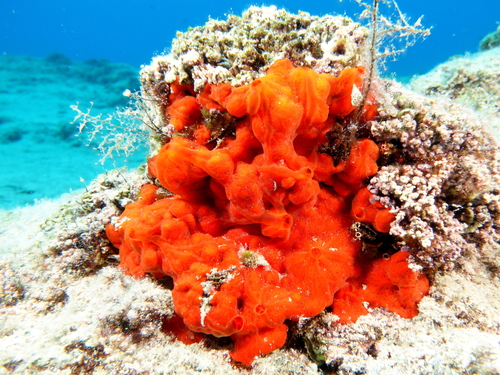
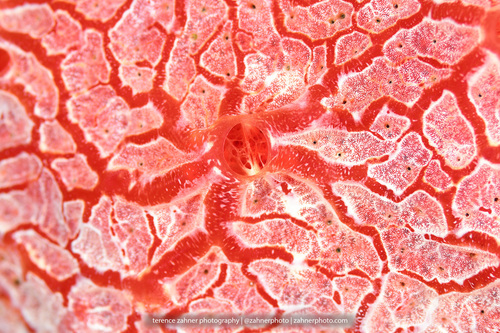
Monanchora arbuscula is a demosponge that grows in either encrusting or bushy forms, and is dark red or bright scarlet across both its surface and interior. It forms masses that can be short or tall, and individual specimens may take on a bushy, rounded, or fan shape. Scattered openings called oscula are scattered across its body, each surrounded by a white collar arranged in a star-like pattern. These collars are formed from exhalant canals, which are not always visible. A small number of oscula sit at the tips of short tube-shaped lobes, and many small knobs called lamellae cover the sponge's surface. Specimens of this species often have different combinations of spicule types that anchor the sponge to its substrate. When specimens lack one or more of these spicule types, identifying them becomes difficult. For example, encrusting specimens have fine filaments of roughly tylostyle spicules, while bushy specimens have a central mesh of spicules surrounded by spongin. When removed from water, the sponge's exhalant canals collapse, and its red-orange interior color fades. Handling this sponge will stain human skin, due to the soft consistency of its tissue, though its interior skeleton is very tough. Monanchora arbuscula occurs in brackish water and is associated with reefs. It is found at depths between 2 and 58 meters (6.6 to 190.3 feet) in tropical habitats of the Western Atlantic. It may grow as an encrusting layer on various organisms and structures in shallow reefs, including dead corals, mollusc shells, and gorgonian axes. It can also be found on hard bottom substrate, or within mangrove ponds.