About Monachus monachus (Hermann, 1779)
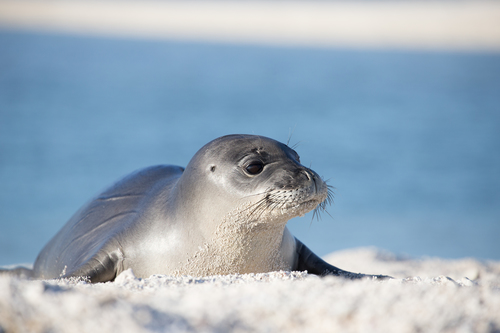
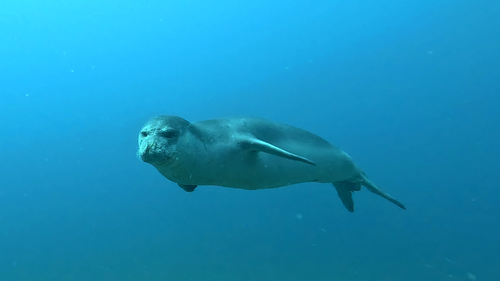
Monachus monachus, the Mediterranean monk seal, ranges from approximately 80 centimeters (2.6 ft) long at birth to an average adult length of 2.4 meters (7.9 ft), with females being slightly shorter than males. Adult males average 320 kilograms (710 lb) in weight, while adult females average 300 kilograms (660 lb); overall, the species' weight ranges from 240 to 400 kilograms (530 to 880 lb). Individuals are thought to live up to 45 years, with an average lifespan of 20 to 25 years, and reach reproductive maturity around age four. Newborn pups measure about 1 meter (3.3 ft) long and weigh 15 to 18 kilograms (33 to 40 lb). Their skin is covered in 1 to 1.5 centimeter-long dark brown to black hair, with a white stripe on the belly that differs in shape and color between sexes: the stripe is usually rectangular in females, and butterfly-shaped in males. This natal hair is replaced after six to eight weeks by the short hair that adult Mediterranean monk seals carry. Adults molt annually, which causes changes in their color vibrancy throughout the year. Both jaws hold eight pairs of teeth. The Mediterranean monk seal is believed to have the shortest hair of any pinniped. Adult male fur is black, while adult female fur ranges from brown to dark grey; all adults have a paler belly, which is nearly white in males. The species has a short, broad, flat snout with very distinct, long nostrils that face upward, unlike the more forward-facing nostrils of its relative, the Hawaiian monk seal. Its flippers are relatively short, with small, slender claws. Unlike most other pinnipeds, Mediterranean monk seals have two pairs of retractable abdominal teats. Pregnant Mediterranean monk seals typically use inaccessible undersea caves for giving birth; however, historical records show they used open beaches for this purpose until the 18th century. The species' habitat has changed over time. From ancient times up through the 20th century, Mediterranean monk seals congregated, gave birth, and sought refuge on open beaches. In more recent times, they have abandoned this former habitat and now only use sea caves for these activities. These caves are often inaccessible to humans, frequently have underwater entrances, and are mostly located along remote or rugged coastlines. Scientists have confirmed this is a recent adaptation, most likely triggered by rapid human population growth, increased tourism and industrial activity, which have led to more human disturbance and destruction of the species' original natural habitat. Due to the seal's shy nature and sensitivity to human disturbance, it has slowly adapted to avoid human contact entirely over the last century, and possibly earlier. Coastal caves are dangerous for newborns, however, and are a major cause of pup mortality when sea storms hit the caves. Today, the Mediterranean monk seal is found in the Mediterranean Sea off Croatia, Cyprus, Greece, and Turkey, and in the North Atlantic Ocean off Mauritania and Western Sahara. It is considered locally extinct (extirpated) in and around Albania, Corsica, Egypt, France, Italy, Libya, Malta, Monaco, Montenegro, southern Spain (including the Balearic Islands), and Tunisia. Its status in Algeria, Israel, Lebanon, Morocco and Syria is unknown. Historically, the species' range extended from the northern Atlantic coastline of West Africa east to the Black Sea, including all Mediterranean offshore islands, the Canary Islands, Madeira, Desertas, Porto Santo, and as far west as the Azores. Vagrants have been recorded as far south as The Gambia and the Cape Verde (Cabo Verde) islands, and as far north as Portugal, northern Spain, the Bay of Biscay, and the coast of Brittany. Multiple factors caused a dramatic population decline over time: commercial hunting, especially during the Roman Empire and Middle Ages; 20th century eradication by fishermen, who considered the seal a pest because it damages fishing nets when feeding on caught fish; and coastal urbanization and pollution. A small number of seals still survive in the Sea of Marmara, but the last recorded sighting of a Mediterranean monk seal in the Black Sea dates to 1997. The species was present at Snake Island until the 1950s, and sites including the Danube Plavni Nature Reserve and Doğankent were the last known haul-out sites after 1990. Currently, the total global population is estimated at fewer than 700 widely scattered individuals, qualifying the species as endangered. The species' very small, sparse population is an additional serious threat: only two key sites across the entire range hold viable populations. The first is the Aegean Sea, which hosts 250 to 300 individuals in Greece (with the largest concentration on Gyaros island) and around 100 individuals in Turkey. The second viable subpopulation is in the Atlantic Ocean, in the Western Saharan portion of Cabo Blanco, with around 270 individuals that may support the small, growing group on the Desertas Islands, which numbers approximately 30 to 40 individuals. A small number of individuals may use coastal areas in other parts of Western Sahara, such as Cintra Bay. These two key viable sites are located at nearly opposite ends of the species' current distribution range, making natural population exchange between them impossible. All other remaining subpopulations have fewer than 50 mature individuals, and many are only loose groups of extremely small size, often with fewer than five individuals. Other remaining small populations exist in southwestern Turkey and the Ionian Sea, both in the eastern Mediterranean. The species is effectively extinct in the western Mediterranean, which only holds tiny Moroccan and Algerian populations, with rare sightings of vagrants in the Balearic Islands, Sardinia, and other western Mediterranean locations including Gibraltar. The last confirmed sightings in Sardinia were in May 2007 and April 2010, and increasing sightings there suggest the species occasionally uses the central eastern Sardinian coasts, which have been protected since 1998 by the National Park of Golfo of Orosei. Colonies on the Pelagie Islands (Linosa and Lampedusa) were destroyed by fishermen, which likely resulted in local extinction. Very little is known about the reproduction of the Mediterranean monk seal. As of 2020, it is estimated that roughly 500 breeding pairs remain worldwide. Scientists suggest the species is polygynous, with males holding distinct territories where they mate with females. While there is no fixed breeding season and births occur year-round, there is a birthing peak in September, October, and November. Mating takes place in the water, while females give birth and care for pups on beaches or in underwater caves. The use of underwater caves for breeding is thought to have developed because these sites are difficult for predators to access. Females stay with their pups to nurse and protect them, and rely on their stored fat reserves to support lactation. Data analysis shows that only 29% of pups born between September and January survive. The low survival rate is partially due to high surf common in breeding areas during this period, which threatens young pups. Additionally, if a female judges her environment is unsafe, she may abort her pregnancy, which indirectly lowers population growth. Small population size also increases the risk of harmful genetic events such as inbreeding and reduced genetic variation. During other months of the year, the estimated pup survival rate is 71%. In 2008, lactation was recorded on an open beach, the first such record since 1945, which suggests the species may be starting to feel safe enough to return to open beaches for breeding at Cabo Blanco. Pups take their first swim two weeks after birth and are weaned at around 18 weeks of age; females caring for pups leave to feed for an average of nine hours at a time. Most females are believed to reach maturity at four years of age, when they begin breeding. Males start breeding at six years of age. The gestation period lasts close to a year, though gestation is thought to be slightly longer than a year for individuals in the Cabo Blanco colony.