About Monacanthus ciliatus (Mitchill, 1818)
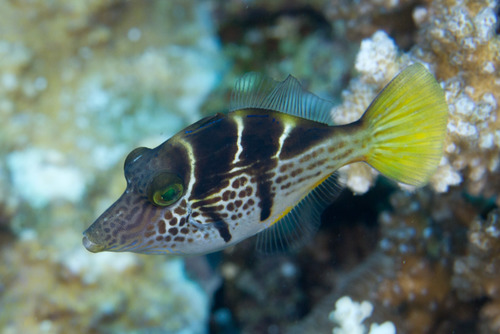
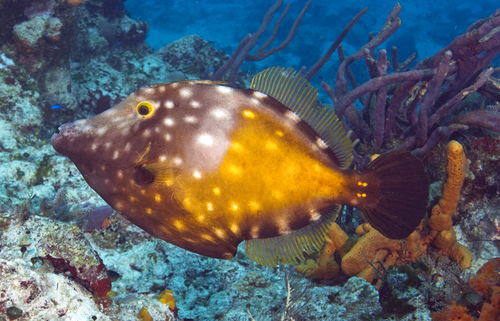
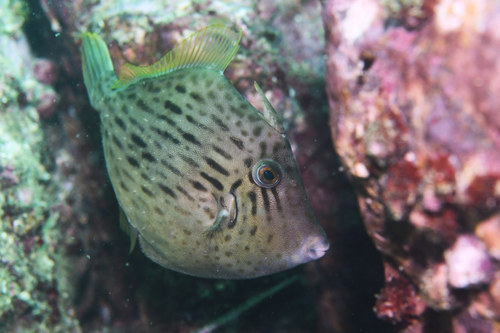
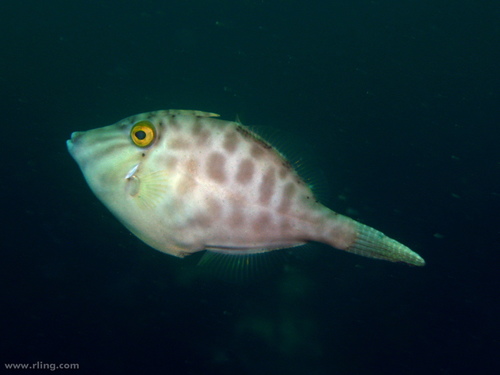
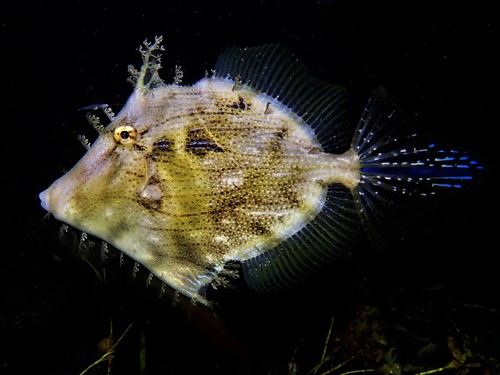
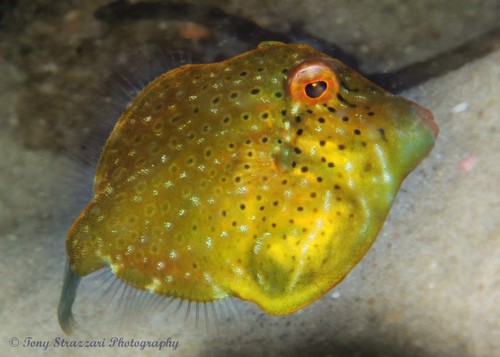
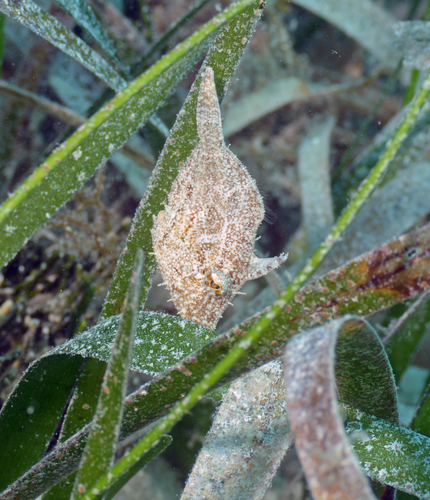
Monacanthus ciliatus, commonly called the fringed filefish, is a laterally flattened fish with a deeply keeled body and a dewlap on its underside. It typically reaches 10 to 14 cm (4 to 6 in) in length, with a maximum recorded length of 20 cm (8 in). This fish has large eyes, a short pointed snout, a small mouth, and strong teeth. Its dorsal fin is split into two sections: the front section sits just behind the eyes and contains two spines, where the first spine is long and erectile and the second is very small; the rear section is positioned further back and is made entirely of soft rays. The pectoral fins are small, and the pelvic fin has a spine-like shape. The caudal fin is short and fan-shaped, formed of branched soft rays. The fish’s skin is covered in very small scales that give it a leathery texture, and it is also dotted with scattered small, pointed, fleshy growths. Its body color changes to match its surroundings: it is greenish in seagrass meadows, and brown or tan on reefs or in sandy areas. It has irregular darker longitudinal stripes, and often has a large black spot on its dewlap.
The fringed filefish occurs in shallow waters of the western Atlantic Ocean, ranging from Newfoundland to Argentina, including the Caribbean Sea and the Gulf of Mexico. It has also been recorded off the eastern Atlantic coasts of Europe and Africa. It is most common in seagrass meadows, but also frequents coral rubble, sandy areas, and sometimes rocky areas. It is a demersal fish, found at depths between 5 and 20 m (16 to 66 ft).