About Mompha terminella Westwood
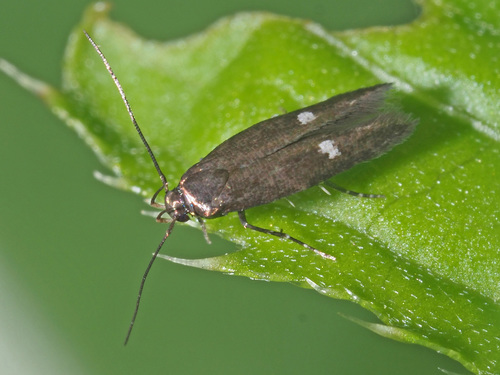
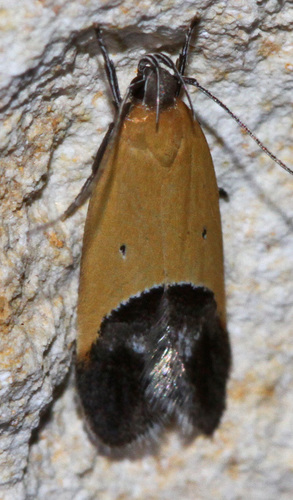
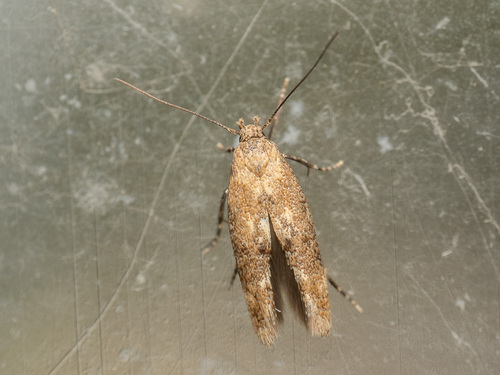
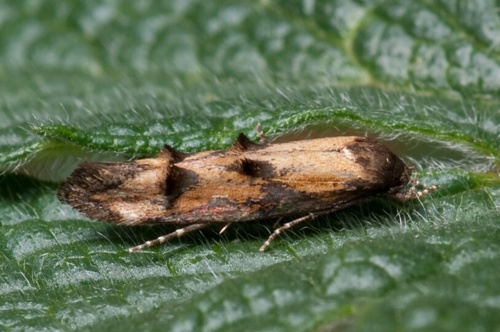
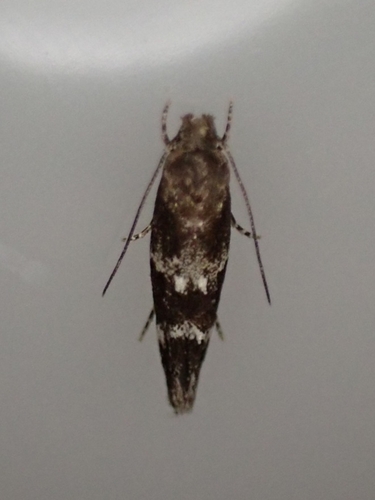
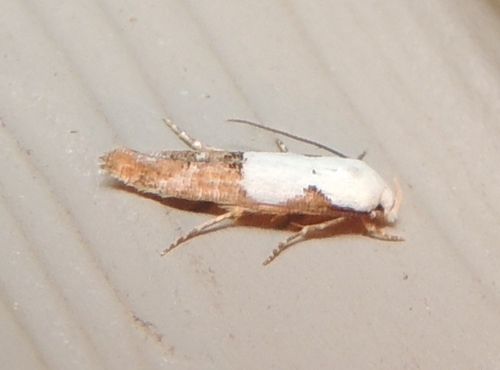
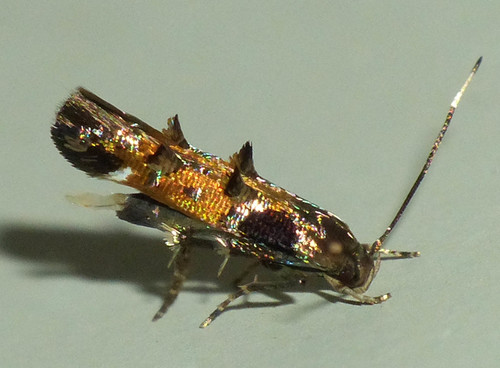
Mompha terminella Westwood is a moth species with a wingspan of 8 to 10 millimeters. The head is dark leaden-metallic, while the face is silvery. The tips of the antennae are white. The forewings are orange, and may sometimes be suffused with purple or brown; the forewing ground colour is specifically dark orange. There is a black blotch at the base of the costa, which is margined with silver-metallic spots. A lead-coloured spot extends from the base of the forewing to one-third of the wing's length, reaching from the costal vein to the inner edge of the wing at the base. The stigmata and a spot above the tornus are silver-metallic and black-edged, with the first discal spot being whiter. The apex of the forewing is black; it is preceded on the costa by a white spot, and on the termen by a silver-metallic mark. The hindwings are dark fuscous. Larvae are whitish, with a green dorsal line and a yellowish brown head; they also have been described as whitish with a light brown head. Larvae develop inside irregular blotch mines in host leaves, which are initially spiral. They feed on the leaves of enchanter's nightshade (Circaea lutetiana) and small enchanter's nightshade (Circaea alpina) by mining the leaves. Larvae can be found from mid-August to mid-September. Adult moths, called imagos, are seldom observed freely in the wild. Adults have one generation per year, and are active on the wing from July to August. This species is distributed from Fennoscandia to the Iberian Peninsula, and from Ireland to Romania; it is also found in North America.