About Mompha propinquella Stainton
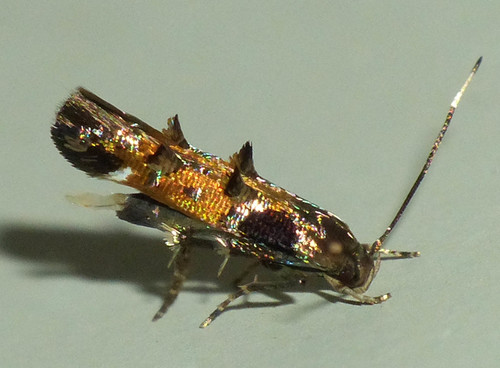
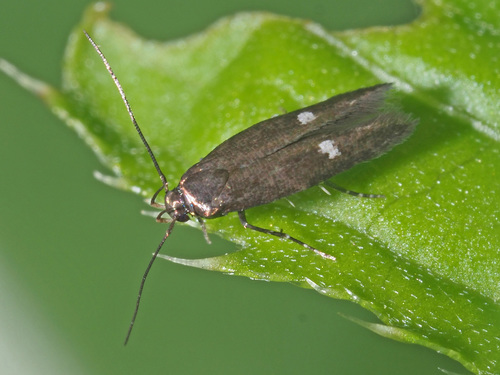
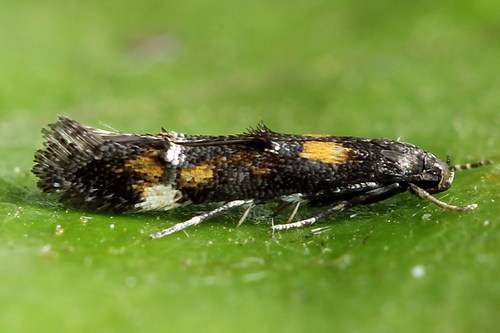
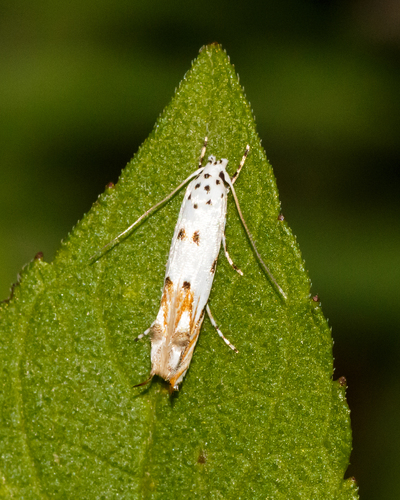
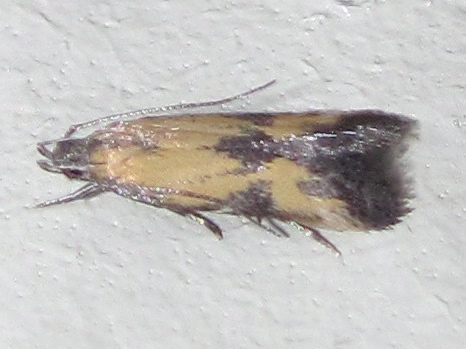
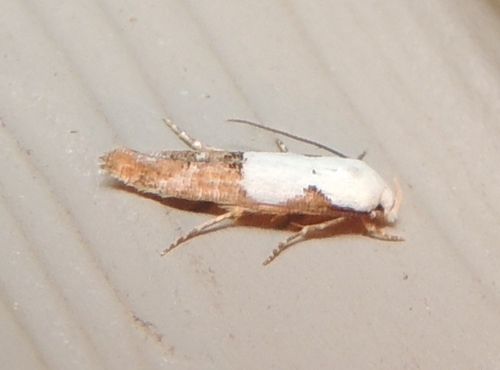
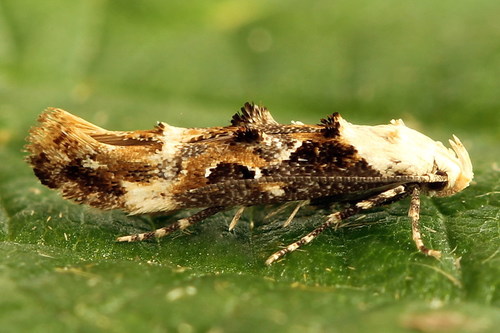
Mompha propinquella Stainton has a wingspan of 10–12 mm. The head and thorax are ochreous-white. Forewings are dark leaden fuscous, with several small scattered orange ferruginous spots across the dorsal half; it has an ochreous-white triangular blotch on the base of the dorsum that almost touches the base of the costa, with one or two white dots beyond this blotch. There are three black scale-tufts toward the dorsum, and another three scale-tufts above these. A white and ferruginous line runs from the costa before the middle, curving around the central tuft. There is a small white tornal spot and a larger white costal spot beyond it, and the disc near these spots is suffused with ferruginous. Hindwings are dark fuscous. The larva is brown, marbled with pale markings, and has a black head and black second thoracic segment plate. Larvae develop inside leaf blotch mines on Epilobium hirsutum, and the cocoon forms inside the mine. This species closely resembles Mompha lacteella (Stephens, 1834) and Mompha ochraceella (Curtis, 1839). Adults are active on wing from the end of June to mid-September, with one generation produced each year. Larvae feed on great willowherb (Epilobium hirsutum) and broad-leaved willowherb (Epilobium montanum), mining the leaves of their host plants. This species overwinters in the larval stage. It is distributed across most of Europe, excluding the Mediterranean islands and most of the Balkan Peninsula.