About Mompha locupletella (Denis & Schiffermüller), 1775
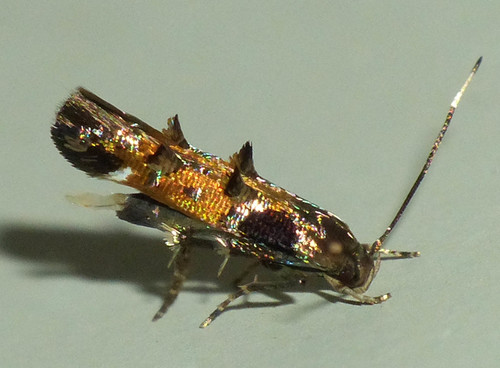
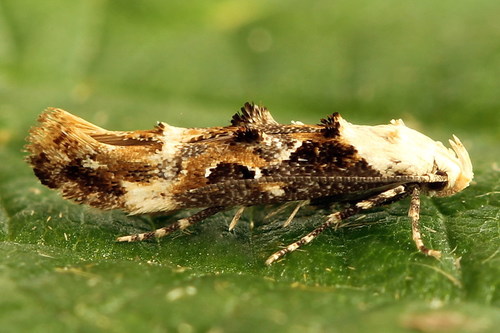
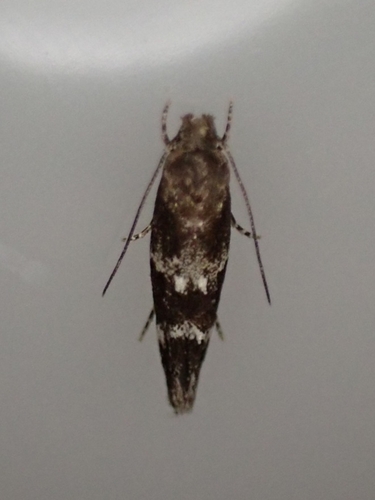
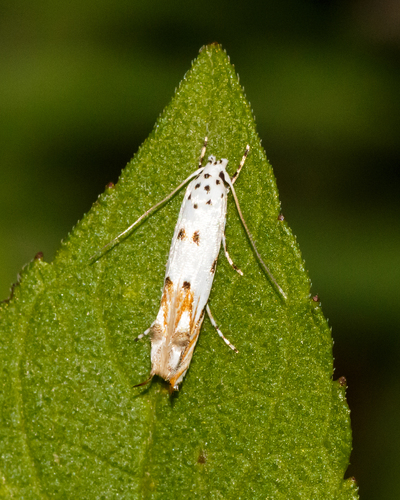
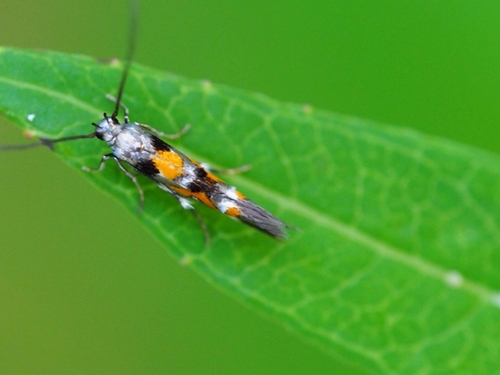
Mompha locupletella (Denis & Schiffermüller), 1775 has a wingspan of 9–12 millimetres (0.35–0.47 in). Its head is dark leaden-metallic. In female individuals, the apex of the antennae is white. The forewings are orange, sometimes suffused with purple-brown. There is a black basal blotch that extends along the costa; it is preceded and followed by leaden-metallic spots on the costa, and the posterior spot is often connected to a leaden-metallic, black-edged spot beyond it on the dorsum. A wedge-shaped mark along the middle of the costa, and an oblique mark from the dorsum before the tornus, are both leaden-metallic and black-edged. There is a blackish apical patch, preceded by a whitish costal spot. The hindwings are dark fuscous. The larva is greyish-green, with a black head and black second segment plate. It develops in leaf blotches on Epilobium alsinifolium. The forewing ground colour is bright orange, decorated with white and silvery-grey marks. This species closely resembles Mompha terminella. There are generally two generations per year, although only one generation occurs in the north. Adults of the first generation are on wing from the second half of May to the beginning of July. Second generation adults are on wing from August to the beginning of September. The larvae feed on Epilobium alpestre, Epilobium alsinifolium (chickweed willowherb), Epilobium lanceolatum (spear-leaved willowherb), Epilobium montanum (broad-leaved willowherb), Epilobium palustre (marsh willowherb), and Epilobium roseum. Larvae can be found from April to May, and from July to the beginning of August. Mompha locupletella is distributed across northern Europe and mountainous areas of central and southern Europe, reaching as far southwest as north-western Spain. To the east, its range extends into Russia, to Zabaykalsky Krai and the Kuril Islands.