About Mompha langiella (Hübner, 1796)
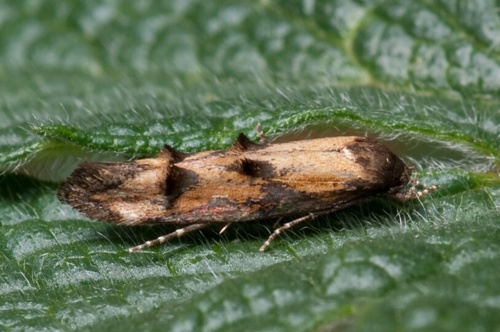
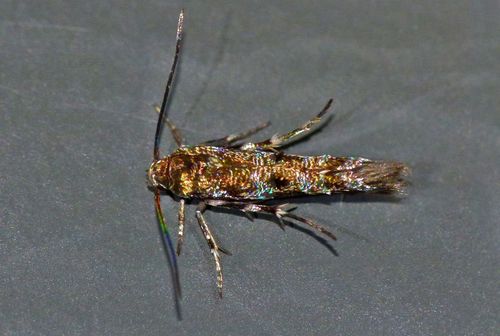
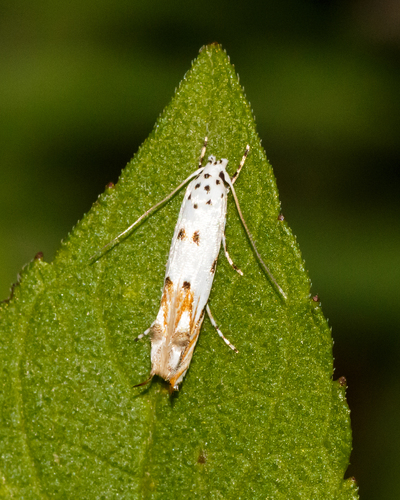
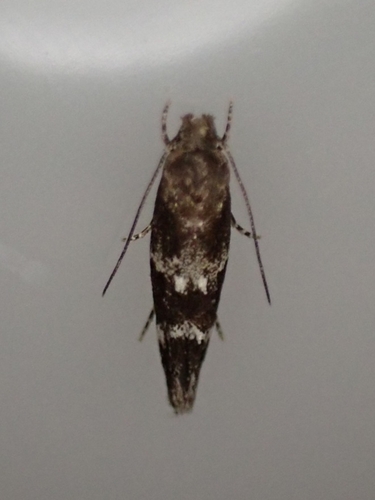
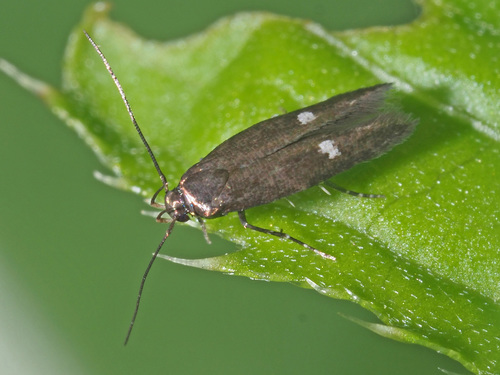
Mompha langiella (Hübner, 1796) has a wingspan of 10–11 millimetres (0.39–0.43 in). Its head is dark brown with a slight purple sheen, and its frons is white. The antennae are dark brown in the first third, ringed with grey and dark brown in the middle third, and grey in the last third. The thorax and forewings are brownish black with a purple sheen. An irregular white spot sits outside the centre of the forewings; sometimes additional white scales are also present at one-third of the forewing length along the fold. The costa has sparse specks of white scales in its outer half and at the wing apex. Hindwings are grey-brown, the abdomen is brownish black. The anal tuft is grey in males and white in females. In males, the uncus is slender with a rounded tip. The cucullus is slender, widest subapically, and has a blunt apex. The sacculus is longer than the cucullus, and tapers to a sharp, slightly curved tip. The gnathos is wide and only slightly sclerotized. The anellus lobes are small and rounded. The aedeagus is slender and has a fairly large cornutus, which is wide at the base and slim and curved at the apex. In females, the ostium is very wide and cup-shaped. The posterior third of the bursae duct is wide, weakly sclerotized, and lined with two short, strongly sclerotized edges. The front part of the bursae duct tapers and bears large sclerites. The seminal duct originates at approximately one-third of the total length of the bursae duct. The corpus bursae is oval, tapers slightly toward the rear, and has two large crescent-shaped signa.