About Mompha epilobiella Römer, 1794
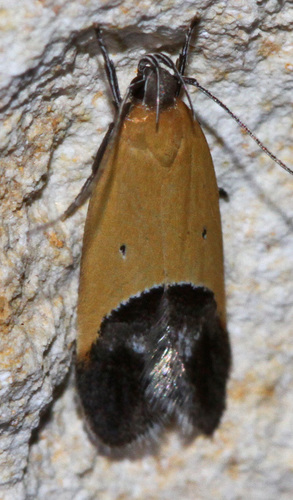
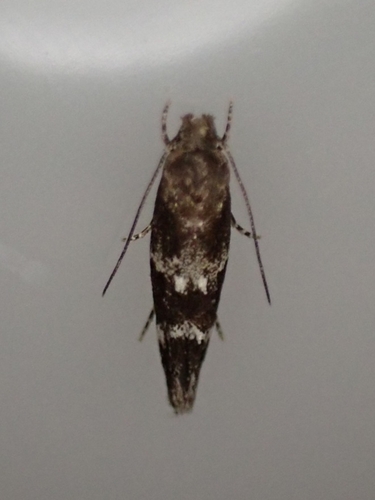
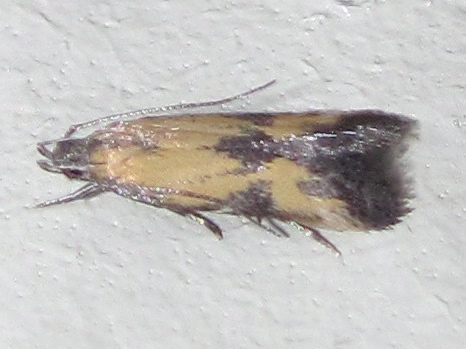
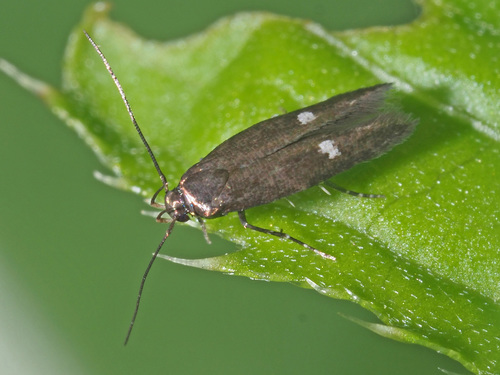
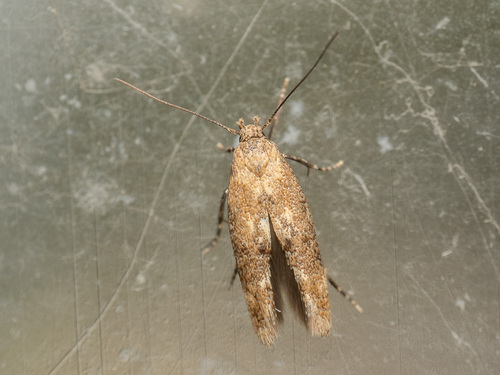
Mompha epilobiella Römer, 1794 has a wingspan of 10–13 millimeters. Its head is yellowish white with brown speckles, and its thorax is ochre-colored. The forewings are primarily ochre, with greyish coloration along the costal vein. An indistinct yellow spot is located on the costa at three-quarters of the forewing length, and a similar yellow spot sits at the inner angle. Two small tufts of slightly protruding dark brown scales are found at one-fifth of the forewing length, and in the middle of the wing's inner edge. The hindwings are shiny grey. Males can be distinguished from the similar species Mompha subbistrigella by specific traits: the saccule is shortened and bears a group of small teeth at its apex, while the aedeagus has one hook-shaped cornutus and several straight cornuti. In females, the eighth tergite is rounded at its posterior end. The duct of the bursa copulatrix has a narrow, short posterior section and an abruptly widened anterior section; both sections have a noticeable sclerotized plate with strongly sclerotized edges. Adults are on wing throughout the year, but are most common during July and August in Great Britain. Larvae of this species have been recorded feeding on rosebay willowherb (Chamerion angustifolium), great willowherb (Epilobium hirsutum), broad-leaved willowherb (Epilobium montanum), marsh willowherb (Epilobium palustre), and evening primrose (Oenothera species). Great willowherb is confirmed as the main food plant, and records of the other listed plants may stem from misidentification. Young larvae are thought to live as leaf miners, while older larvae live mostly communally in spun uppermost leaves. This species has a Holarctic distribution, and is found across all of Europe and in North America, including Ontario.