About Momotus mexicanus Swainson, 1827
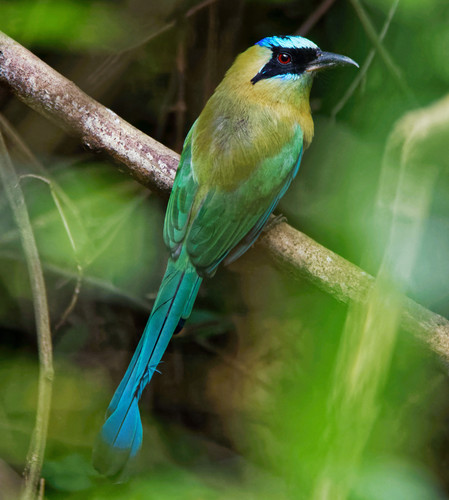
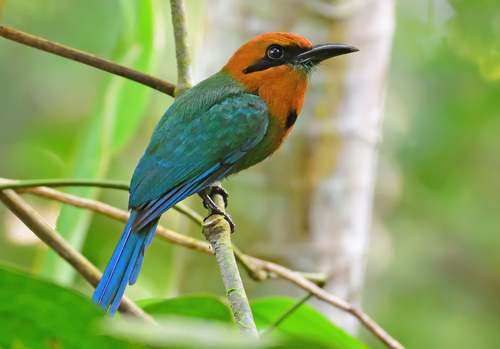
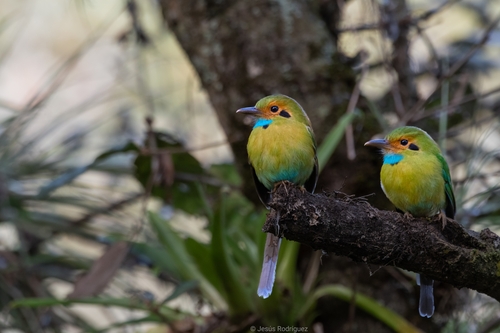
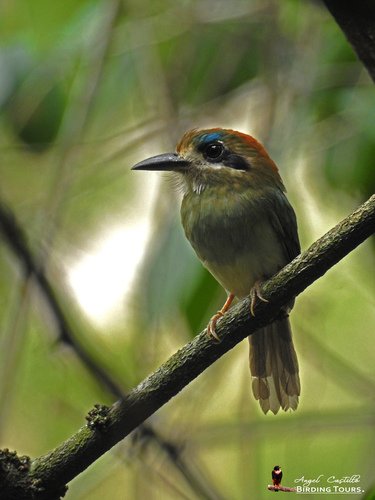
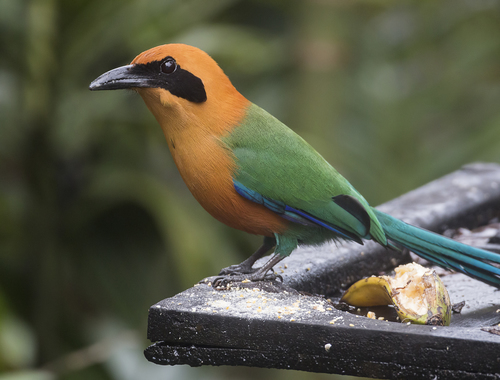
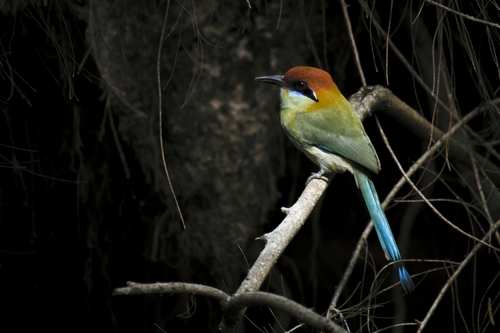
Russet-crowned motmots (Momotus mexicanus Swainson, 1827) are relatively small motmots, measuring 30.5 to 35.5 cm long and weighing 74 to 104 g. Like most motmots, they do not show sexual dimorphism in plumage. However, females have shorter tail feathers, ranging from 10 to 15 cm, while male tail feathers measure 11 to 22 cm. They have a rufous crown and nape, a green back, and green wings with blue-green primary feathers. Their chest is pale green with a black spot, and their underbelly is even paler. They have a long blue tail with a bare section near the tip of the longest central feathers, creating a dark racket-shaped tip. Their black bills curve downwards and have a slightly serrated edge. Like most motmots, they have a black eye mask lined with blue and violet feathers, reddish eyes, and grey legs and feet. Juveniles have brown eyes and duller plumage. Four recognized subspecies differ in morphology: compared to the nominate subspecies M. m. mexicanus, M. m. vanrossemi is paler, M. m. saturatus is larger and darker, and M. m. castaneiceps has a darker chestnut crown and a more extensive black eye mask. In terms of distribution and habitat, russet-crowned motmots prefer old-growth forests with closed canopies, but also occur in secondary forests with substantial canopy coverage. They inhabit dry and humid tropical forests and clearings up to 1,800 m in altitude. They are found along the western coast of Mexico, with an isolated population in central Guatemala, and are common across their native range. The subspecies M. m. vanrossemi occurs in northwestern Mexico, in Sonora, Sinaloa, and Chihuahua. M. m. mexicanus ranges along the west coast from Sinaloa to Oaxaca. M. m. saturatus is found in southwestern Mexico and Guatemala. M. m. castaneiceps was previously an isolated population restricted to the Motagua Valley of central Guatemala; in 2018, its distribution was recorded extending to the Nentón valley in Huehuetenango, suggesting its range may be expanding into western Guatemala. Russet-crowned motmots are socially monogamous. Pairs form during the breeding season, and both parents care for the brood, with labor equally divided between the pair. The breeding season falls between May and July, during the wet season, and the species typically breeds once per year. Females lay a small clutch of 4–5 eggs per breeding season, which is typical for tropical birds. The incubation period lasts 15 to 20 days. Both males and females feed hatchlings, and fledglings leave the nest 30 to 42 days after hatching. This species has a 68% hatching success rate and a 56% fledgling success rate; 83% of hatchlings successfully fledge. Most mortality occurs during incubation, and brood predation is primarily caused by snakes and iguanas. Russet-crowned motmots are burrow-nesting birds. Each mating pair digs a horizontally flat tunnel 88 to 170 cm deep into an earthen bank, roadside bank, or river bank. Tunnels may curve, and end in an egg chamber. Tunnels are only used for breeding, but breeding sites form multi-purpose territories that the birds also use for foraging, roosting, and other activities. Nest tunnel survival depends heavily on substrate quality: unsuitable substrates can lead to flooding or collapse of the tunnel. Good nesting sites are hard to find and limited by soil type. Loam-textured soils, which contain a mix of sand, silt, and clay, are the best nesting substrates because they have better drainage, are easier to excavate, and provide improved ventilation. Because suitable nesting sites are scarce, russet-crowned motmots are strongly sedentary, and will return to previous nesting grounds as they already know the site quality, food sources, shelters, predators, and past breeding performance of the area.