About Momotus bahamensis (Swainson, 1838)
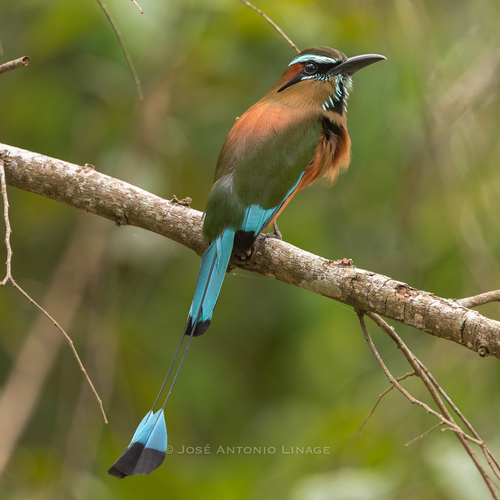
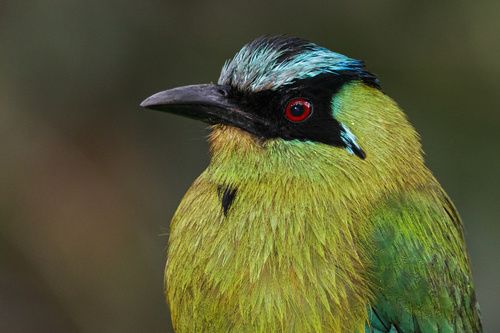
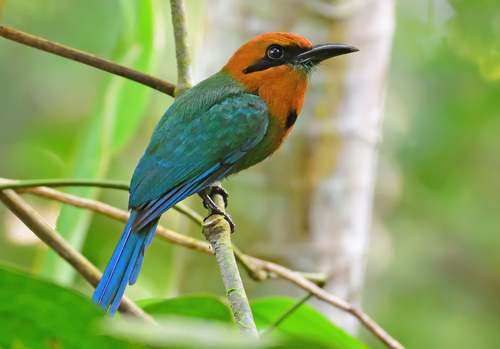
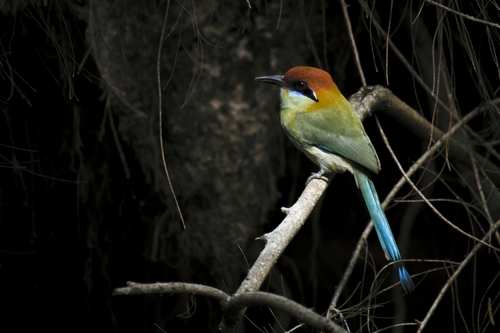
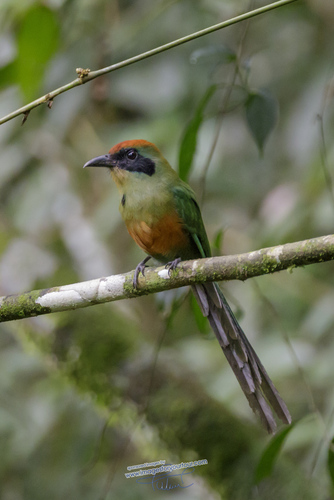
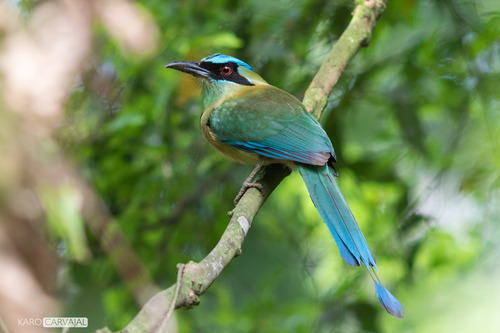
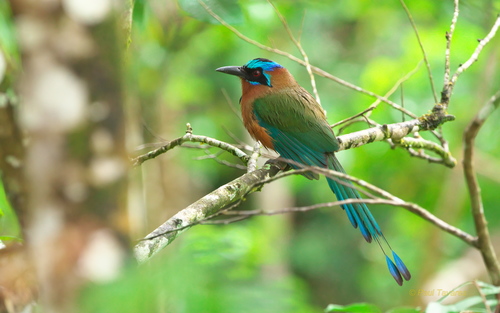
The Trinidad motmot (scientific name Momotus bahamensis (Swainson, 1838)) has much deeper and more uniform rufous underparts than other species in the Momotus genus. Its throat is a deep, intense reddish-brown, while the breast is slightly paler and often has a faint lateral olive-green wash. The abdomens of these birds are almost as dark as their breasts, and their thighs contrast sharply with their green or blue-green colouring; this contrast is much stronger than in other Momotus species. The species' black pectoral feathers have broad, conspicuous turquoise borders, and tibial feathers are green to blue-green. Adult individuals have a short black streak across the breast, a feature that is absent in juveniles, along with the lack of blue breast feathers, which allows easy age identification. Males and females have similar appearance, and the Trinidad motmot does not typically show sexual dimorphism. Extensive blue areas surrounding the Trinidad motmot's mask distinguish it from all other members of its genus. Some individuals may have a noticeable blue-to-turquoise border that fades into green just before the diadem, while other individuals have fainter, less prominent feathers in this area. In size and morphology, the Trinidad motmot reaches a total length of approximately 46 cm (18.1 in) and has an average weight of 111.4 g (3.9 oz). Wing length differs between the sexes: males have an average wing length of 135.2 mm (5.3 in), with a range of 133 to 138 mm (5.2 to 5.4 in), while females have an average wing length of 137.9 mm (5.4 in), with a range of 133 to 142 mm (5.2 to 5.6 in). Male tail lengths range from 214 mm (8.4 in) to 240 mm (9.4 in), and female tail lengths range from 215.5 mm (8.5 in) to 235.0 mm (9.3 in). This bird has significantly larger bill and tail measurements than other members of the Momotus genus. The Trinidad motmot is a nonmigratory bird that lives only on the islands of Trinidad and Tobago, and it is more abundant in Tobago than in Trinidad. It primarily occupies forested and wooded regions, including both lowland and coastal forests. The species is adaptable, and can also be found in marine intertidal zones that have existing wooded environments. This species is unique in that its geographic isolation is more pronounced than that of any other member of the Momotidae family, because it is restricted to these islands. Its nonmigratory behavior also means the species is unlikely to expand beyond its current estimated extent of occurrence of 11,700 square kilometres. There is a notable lack of information about the distribution of Trinidad motmot populations across the islands, including the exact number of mature individuals and whether population numbers have increased or decreased in recent years. Despite this gap in data, the current population is believed to be stable with no significant fragmentation, and the average generation length of the species is estimated to be approximately 3.6 years. While the species' upper elevation limit is not well-documented, its lower elevation limit is 0 m (0 ft), or sea level. Trinidad motmots have shown an ability to survive in urban and artificial habitats, including plantations, pastures, and even rural gardens. This adaptability may support the species' resilience. There are no known major threats to the Trinidad motmot, so its population is expected to remain stable or potentially increase in the coming decades.