About Momordica cochinchinensis (Lour.) Spreng.
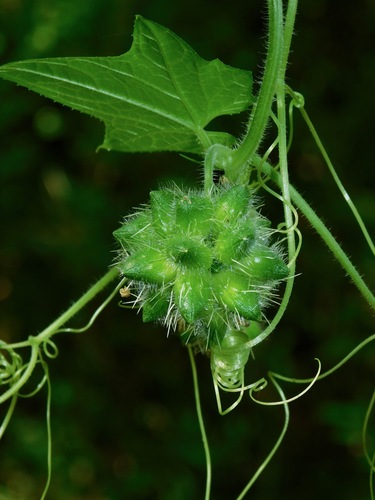
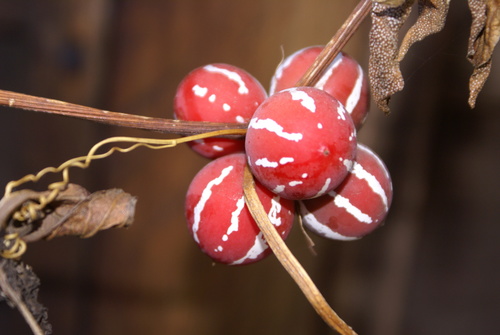
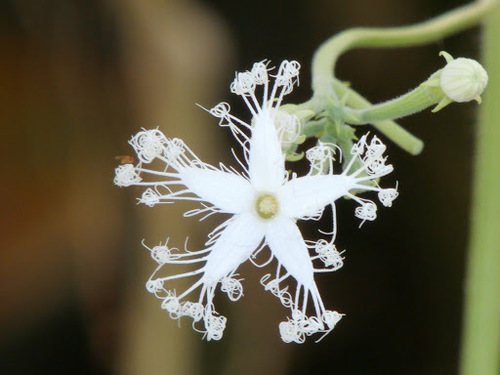
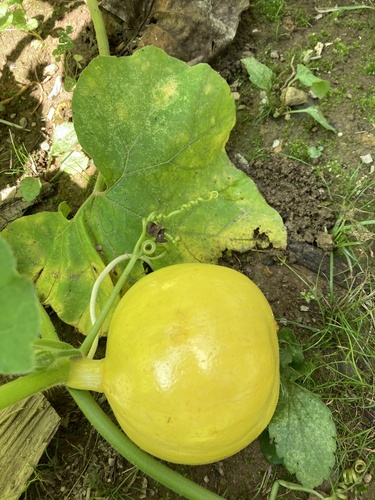
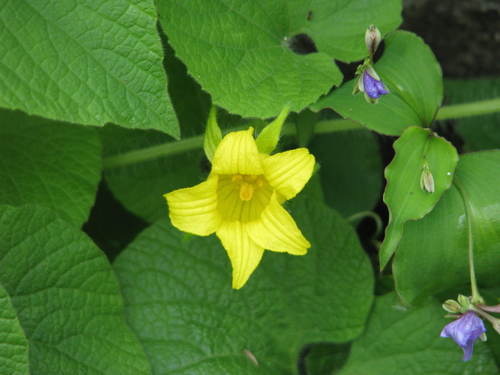
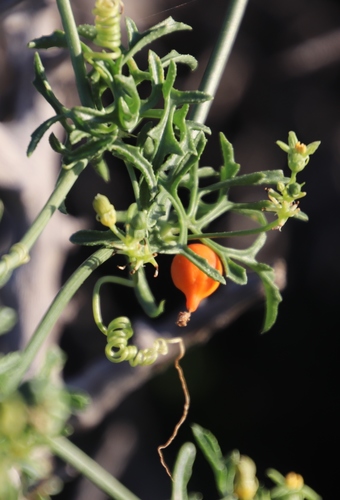
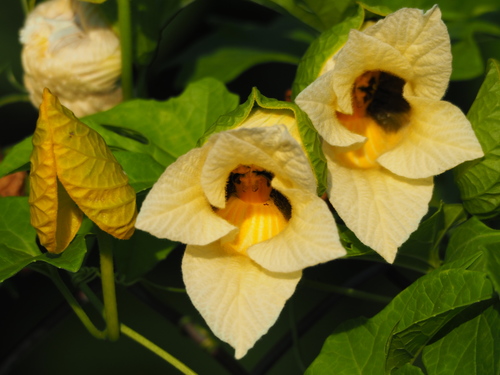
Momordica cochinchinensis, commonly called gac, is a perennial tendril climbing plant that can grow up to 15 metres (50 feet) long, with a stem diameter reaching up to four centimetres (1+1⁄2 inches). Its palmate leaves have 3 to 5 lobes, grow on 6–10 cm (2+1⁄2–4 in) long petioles (leaf stems), are arranged alternately along stems, and can measure up to 20 cm (8 in) in both width and length. This species is dioecious, meaning male and female flowers grow on separate individual plants. On male plants, inflorescences are either single solitary flowers or racemes up to 10 cm (4 in) long, while female flowers are always solitary. All flower buds are completely enclosed by bracts, which split open as the flower matures. Mature flowers have five yellowish petals and a black centre. The fruits are ovoid to broadly ellipsoid, measuring about 15 cm (6 in) long by 10 cm (4 in) in diameter, with skins covered in numerous small spines. Unripe fruits are green, and turn deep orange-red when mature. They hold many irregularly shaped brown or grey seeds, each enclosed in a bright red aril. In the northern hemisphere, this species flowers from June to August, with fruits developing from August to October. In Australia, flowering occurs from December to January, and fruits develop from February to April. Because gac is dioecious, both male and female plants are required for female plants to produce fruit, so farmers must grow at least one male plant in or near gardens to pollinate fruit-bearing female plants. When grown from seed, the ratio of male to female plants is unpredictable. Insects can facilitate pollination, but hand pollination produces higher fruit yields. One alternative propagation method is to graft female plant material onto the main shoot of a male plant. For maximum insect-assisted pollination, the recommended ratio is roughly 1 male plant for every 10 female plants. When propagating from vines, farmers make a diagonal cutting around 15–20 cm (6–8 in) long and 3–6 mm (1⁄8–1⁄4 in) wide, then root the cuttings' tubers in water or well-aerated, moist potting media before outplanting. Outside of its native Southeast Asian countries, gac can be grown in subtropical climate regions; cool temperatures stop its growth. Gac has long been used in its native range primarily as food and traditional medicine, with folk medicine use dating back centuries in China and Vietnam. Gac seeds, called mù biē zǐ (wooden turtle seed), are used for a range of internal and topical purposes in traditional medicine. When fruits ripen, the bright red aril surrounding the seeds is cooked with sticky rice to make xôi gac, a traditional Vietnamese dish with a vivid red color served during Tết (Lunar New Year) and other special events. In Sri Lanka, gac is used in curry, and in Thailand it is served with ice cream. Unripe green gac fruit is eaten in parts of India and the Philippines. The spiny outer skin is removed, the fruit is sliced and cooked, sometimes with potato or bottle gourd. In the far northern Philippine province of Ilocos Norte, where it is known by the local names sugod-sugod, parog-parog, and libas, unripe gac fruits are commonly added as a vegetable to dinengdeng and pinakbet, while its blanched young shoots are included in ginisa. Due to its high content of beta-carotene and lycopene, extracts from the fruit's arils are used to make dietary supplements, or sometimes added to food and drinks as a food dye.