About Momordica charantia L.
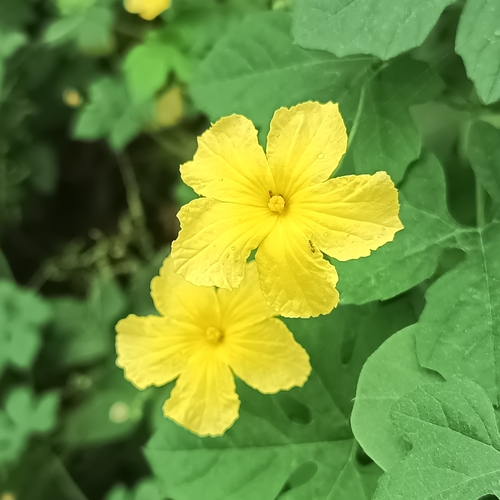
Momordica charantia L. is a herbaceous tendril-bearing vine that reaches up to 5 meters (16 feet) in length. It produces simple, alternate leaves 4–12 cm (1.6–4.7 in) across, with three to seven deeply separated lobes. Each individual plant produces separate yellow male flowers and yellow female flowers. In the Northern Hemisphere, this species flowers from June to July, and produces fruit from September to November. It grows as a frost-tender annual in temperate regions, and as a perennial in the tropics, and grows best in USDA plant hardiness zones 9 through 11. The fruit of Momordica charantia L. has a distinct warty outer surface and an oblong shape. In cross-section, the fruit is hollow, with a relatively thin layer of flesh surrounding a central seed cavity that holds large flat seeds and pith. The fruit is most commonly eaten when it is green, or just as it starts to turn yellow. At this unripe stage, the fruit’s flesh has a crunchy, watery texture similar to cucumber, chayote, or green bell pepper, but is bitter. The skin of the unripe fruit is tender and edible. In unripe fruits, the seeds and pith are white, they are not strongly bitter, and they can be removed before cooking. There is conflicting information about how the fruit changes with age: some sources note that the edible flesh (rind) becomes somewhat tougher and more bitter as the fruit ages, while other sources state that the skin of the common Chinese variety does not change texture, and its bitterness decreases with age. The Chinese variety is best harvested when it is light green, possibly with a slight yellow tinge, or just before this stage. As the fruit ripens, the pith becomes sweet and turns an intense red; in this state, it can be eaten raw and is a popular ingredient in some Southeast Asian salads. When the fruit is fully ripe, it turns orange and soft, and splits into segments that curl back to expose its seeds, which are covered in bright red pulp. Possible adverse effects of Momordica charantia L. include gastrointestinal discomfort. Ripe fruit and mature seeds of this species are toxic. Bitter melon (Momordica charantia L.) has been used in various Asian and African herbal medicine systems.