About Moloch horridus Gray, 1841
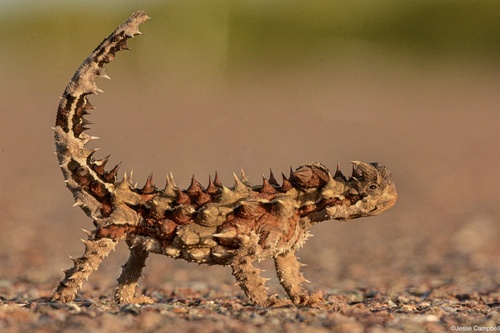
The thorny devil (Moloch horridus Gray, 1841) reaches a maximum total length of 21 cm (8.3 in) including the tail, has a lifespan of 15 to 20 years, and females grow larger than males. Most individuals have camouflage coloration in shades of desert brown and tan, and these colors lighten in warm weather and darken in cold weather. The entire body of the thorny devil is covered in conical, mostly uncalcified spines, with a full set of intimidating spikes across its upper body. These thorny scales help defend the species against predators; it also uses camouflage and deception to avoid predation. When moving slowly in search of food, water, and mates, this lizard has an unusual gait that includes periods of freezing and rocking. It has a spiny "false head" made of soft tissue on the back of its neck, and it presents this false head to potential predators by tucking its real head down. The thorny devil has ridged scales that let it collect water from any body part it uses to touch water, most often its limbs. Capillary action moves water through channels in its skin to the mouth. It is adapted to harvest moisture in the dry desert after cool nighttime temperatures cause dew to form. This process works through contact with moisture, hydrophilic skin surface structures with capillaries, and an internal transport system. The lizard will rub its body against moist substrate and shovel damp sand onto its back, as its outer epidermis is structured to pull in moisture through the skin. Its keratinous, fiber-structured epidermis is hydrophilic, with hexagonal microstructures on the surface of scales. When small amounts of water contact the skin (pre-wetting), these microstructures fill with water, making the skin surface superhydrophilic. This lets moisture spread across a wider area to speed up uptake, as water is collected by capillary action in small channels between the scales. Captured water moves passively via capillary action through semi-tubular channels located beneath partially overlapping scales, forming an asymmetric interconnected system that covers the lizard's whole body. The channels end at the mouth, and active drinking (visible through jaw movements) can be observed when moisture is abundant, such as in water puddles. This same hydrophilic moisture-harvesting biology is also seen in the Texas horned lizard (Phrynosoma cornutum), roundtail horned lizard (Phrynosoma modestum), desert horned lizard (Phrynosoma platyrhinos), Arabian toad-headed agama (Phrynocephalus arabicus), sunwatcher toadhead agama (Phrynocephalus helioscopus), Phrynocephalus horvathi, yellow-spotted agama (Trapelus flavimaculatus), Trapelus pallidus, and desert agama (Trapelus mutabilis). The thorny devil typically inhabits arid scrubland and desert across most of central Australia, including sandplain and sandridge desert in the deep interior and the mallee belt. In Western Australia, its distribution aligns more strongly with regions of sandy loam soil than with a specific climate. Female thorny devils lay clutches of three to ten eggs between September and December. They deposit the eggs in a nesting burrow around 30 cm underground, and the eggs hatch after approximately three to four months.