About Mola tecta Nyegaard, Sawai, Gemmell, Gillum, Loneragan, Yamanoue & Stewart, 2017
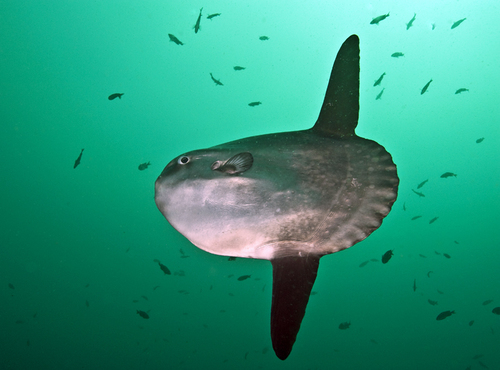
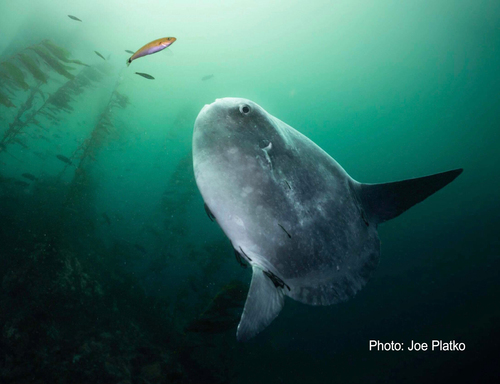
The hoodwinker sunfish (Mola tecta) shares the same genus as the better-known ocean sunfish, Mola mola. Like other species in the Mola genus, it has a flat, near-symmetrical oval body shape. It can be identified by its smooth body, lack of a head bump, rounded snout, and a maximum observed length of 242 cm (about 7.9 feet). It has no spines in its fins and no true caudal (tail) fin; its scales have evolved into small spines. Like cartilaginous fish, Mola tecta displays countershading, meaning its dorsal side is darker than its ventral side. Compared to other Mola species, Mola tecta is slimmer, has a sleeker adult body shape, and lacks a protruding snout and lumps along its tail fin; this lack of tail lumps is the easiest feature to distinguish it from other Mola species. It can reach up to three metres in length and weigh up to two tonnes (2.0 long tons; 2.2 short tons). Parasites have been found in every dissected Mola tecta individual. Mola tecta was first discovered washed ashore on a beach near Christchurch, New Zealand, in 2014, and was formally described as a new species in 2017; it was the first new sunfish species identified in 130 years. It is thought to live primarily in the Southern Hemisphere, and has been recorded in waters off New Zealand, Australia, South Africa, and Chile. Multiple confirmed records of Mola tecta exist from the Northern Hemisphere, including a specimen from Ameland, the Netherlands (previously misidentified as Mola mola) collected in 1889, and a 2.1 m (7-foot) individual that washed up near Santa Barbara, California, in 2019. Another Mola species, Mola alexandrini, has been found in the Southern Pacific. By comparison, Mola mola is the most widespread Mola species, and occurs in all major oceans except polar regions.