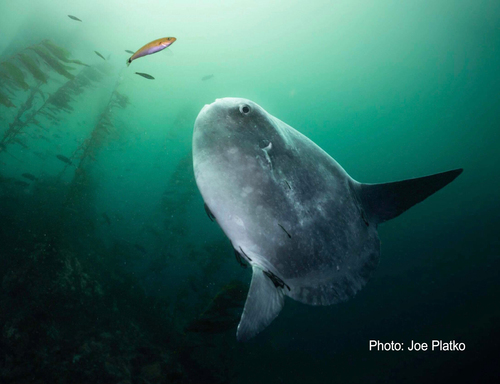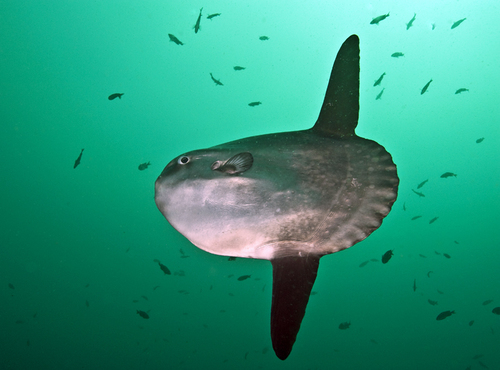
About Mola mola (Linnaeus, 1758)
Mola mola, commonly called the ocean sunfish, belongs to the order Tetraodontiformes, which also includes pufferfish, porcupinefish, and filefish. It shares multiple traits with other members of this order, including a beak formed from four fused teeth; newly developed young sunfish called fry resemble spiky pufferfish far more than they resemble adult Mola mola. The ocean sunfish’s caudal fin is replaced by a rounded clavus, which creates the species’ distinct truncated body shape. Its body is flattened laterally, which gives it a long oval appearance when viewed head-on. The pectoral fins are small and fan-shaped, while the dorsal fin and anal fin are elongated, often making the fish as tall as it is long. Recorded specimens can reach up to 3.3 m (10 ft 10 in) in height. Mature ocean sunfish have an average length of 1.8 m (5 ft 11 in) and a fin-to-fin length of 2.5 m (8 ft 2 in). Mature individuals generally weigh between 247 and 1,000 kg (545 to 2,205 lb), though much larger individuals have been observed. The largest recorded specimen, which washed ashore in New Zealand in 2006, measured 3.3 m (10 ft 10 in) in length and weighed 2,300 kg (5,100 lb). The spinal column of M. mola contains fewer vertebrae and is shorter relative to the fish’s body than the spinal column of any other fish. Although ocean sunfish descend from bony ancestors, their skeletons are made mostly of lighter cartilaginous tissue, which lets them grow to sizes that would not be possible for other bony fishes. Their teeth are fused into a beak-like structure that prevents them from fully closing their mouths; they also have pharyngeal teeth located in the throat. Ocean sunfish completely lose axial musculature during development, and they do not have a swim bladder. Instead, they gain buoyancy from a stiff gelatinous layer under their skin. This layer is around 90% water, with a meshwork of collagen and elastin that acts like an exoskeleton, and it may contain lipids due to its greasy texture. The layer is horizontally divided by a septum, and it makes up a larger proportion of the animal’s total body mass as the individual grows larger. Some sources note that the internal organs of M. mola contain the concentrated neurotoxin tetrodotoxin, similar to the organs of other poisonous tetraodontiformes, while other sources dispute this claim. Ocean sunfish are native to temperate and tropical waters across every ocean in the world. Mola genotypes show wide variation between Atlantic and Pacific populations, but genetic differences between individuals from the Northern and Southern hemispheres are minimal. Early research suggested ocean sunfish moved mostly by drifting with ocean currents, which led to the species sometimes being classified as megaplankton. However, individuals have been recorded swimming 26 km (16 mi) in a single day at a cruising speed of 3.2 km/h (1.7 kn). Contrary to the common belief that these fish spend most of their time basking at the ocean surface, adult M. mola actually spend a large portion of their lives actively hunting at depths greater than 200 m (660 ft), occupying both the epipelagic and mesopelagic zones. Ocean sunfish are most commonly found in water warmer than 10 °C (50 °F); staying in water at 12 °C (54 °F) or lower for extended periods can cause disorientation and eventually death. Surface basking, where a sunfish swims on its side to present its largest profile to the sun, may serve to "thermally recharge" the fish after it dives into deeper, colder water to feed. Sightings of ocean sunfish in colder waters outside their typical range, such as waters southwest of England, may serve as evidence of rising marine temperatures. Ocean sunfish are usually found alone, though they are occasionally encountered in pairs. Ocean sunfish can live up to ten years in captivity, but their lifespan in their natural wild habitat has not been definitively determined. Current estimates for wild lifespan place female life expectancy at around 2 to 23 years, and male life expectancy at 1 to 16 years. The species’ growth rate also remains undetermined, but a young specimen held at the Monterey Bay Aquarium gained weight from 26 to 399 kg (57 to 880 lb) and reached a height of nearly 1.8 m (5 ft 11 in) over 15 months. The large size and thick skin of adult ocean sunfish deter many smaller predators, but younger fish are vulnerable to predation by bluefin tuna and mahi mahi. Adult ocean sunfish are preyed on by orcas, sharks, and sea lions. The mating behavior of ocean sunfish is not well understood, but potential spawning areas have been identified in the North Atlantic, South Atlantic, North Pacific, South Pacific, and Indian oceans. Female ocean sunfish can produce more eggs than any other known vertebrate, producing up to 300 million eggs at a time. Sunfish eggs are released into open water, where they are fertilized externally by sperm. Newly hatched sunfish larvae are only 2.5 mm (3⁄32 in) long and weigh less than one gram. They develop into fry that look like miniature pufferfish, their close relatives. Sunfish fry do not have the large pectoral fins and tail fin of adult sunfish, but they have body spines not seen in adult sunfish that disappear as the fish grow. Young sunfish swim in schools for protection, but they abandon this behavior as they mature. Surviving fry can grow up to 60 million times their original hatching weight before reaching adult size, making this arguably the most extreme size growth of any vertebrate animal.