About Mokopirirakau granulatus (Gray, 1845)
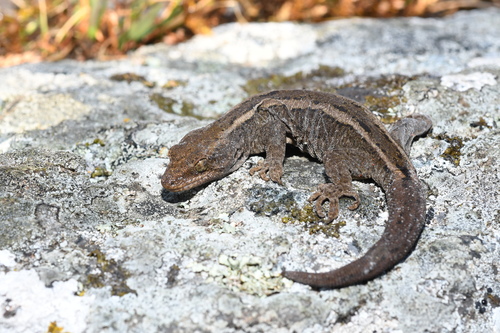
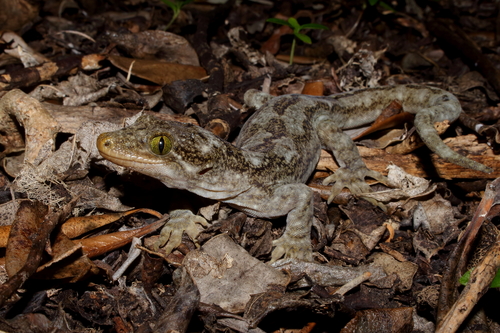
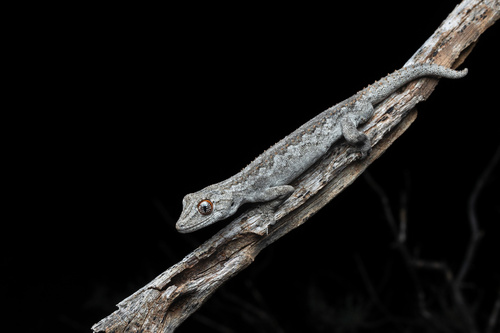
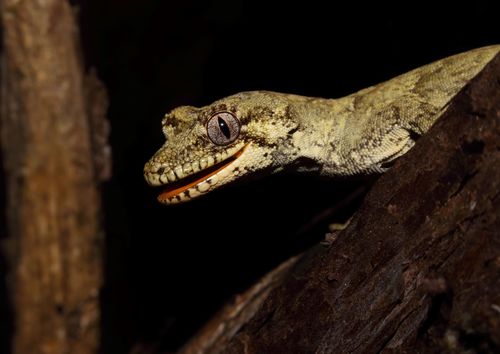
This species, Mokopirirakau granulatus, has brown-grey backs marked with bright W-shaped splotches that resemble tree bark. Individuals from the southern end of the species' range often have brighter red and orange shades. The species can rapidly change its color to match its environment. They have grey bellies, white scales along the mouth edge, and a yellow or orange mouth interior; this mouth color can be used to distinguish them from the Pacific gecko (Dactylocnemis pacificus). Their foot pads are yellow, and northern individuals have slightly shorter toes than southern individuals. They usually measure 70–85 mm from snout to vent, and some individuals reach up to 98 mm in this measurement.
Forest geckos are found on both the North Island and South Island. On the North Island, their range extends from just south of the Bay of Islands down to Taranaki, and along the Bay of Plenty. On the South Island, they occur in Marlborough, Nelson, and Tasman, and extend down the West Coast as far south as Ōkārito Lagoon. They primarily inhabit forests and scrublands, ranging from the coast up to the tree line. Very rarely, they can also be found in creviced rock above the tree line, at elevations up to 1500 m above sea level. They generally live on tree trunks and larger branches; in the northern part of their range, they are also often found on the slender branches of mānuka and kānuka trees.