About Mohoua ochrocephala (Gmelin, 1789)
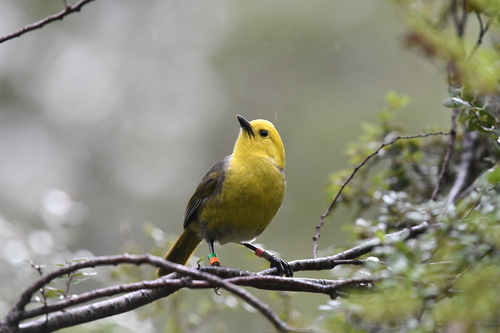
The yellowhead, also called mohua, with the scientific name Mohoua ochrocephala, is a small insectivorous passerine bird that is endemic to the South Island of New Zealand. It was once a common forest bird, but its numbers declined drastically after the introduction of rats and stoats, and it is currently classified as near threatened on the IUCN Red List. This species is found only on the South Island of New Zealand and several small islands surrounding it. While it was abundant in the 19th century, particularly in southern beech forests on the South Island and Stewart Island / Rakiura, mohua declined dramatically in the early 20th century due to the introduction of black rats and mustelids. Their habit of nesting in tree holes makes them more vulnerable to these predators. Today, yellowheads have vanished from almost all of the South Island's forests, and exist in less than 5% of their original range. On the mainland of the South Island, there is currently a small population of mohua in the Marlborough Sounds and around Arthur's Pass, while a quarter of the entire population lives in the beech forests of the Catlins. The total global population of mohua is approximately 5000 individuals. Mohua are cooperative breeders. This behaviour is an evolutionary adaptation to limited resources that benefits the species when mohua populations are abundant, but it does not currently help current population growth, since it results in fewer breeding pairs than would otherwise be possible and thus fewer total offspring. In this cooperative breeding system, a primary breeding pair is assisted by subordinate birds called secondaries. Not all primary pairs are assisted by secondaries. Secondaries can form their own pairs, and some do breed, though they generally produce fewer successful fledglings than primary pairs. Secondary pairs live within the primary pair's territory: they assist the primary pair when mobbing intruders, forage together with the primary pair, and join in territorial singing. Secondary helpers actively feed nestlings, assist with incubation, and take part in territorial behaviour. Male secondary helpers mainly contribute to territorial singing, while female secondary helpers cannot sing, and instead assist with incubation. Secondary helpers do not have to be related to the primary breeding pair, though they are most often males that will become the new primary male of the territory if the existing primary male dies before the next breeding season. Only male mohua sing, and they defend their territory against males from neighbouring territories through singing duels. Primary males also chase other intruding mohua or secondaries. Female mohua are exclusively responsible for building nests and incubating eggs. During incubation, the male guards the female and brings her food. Mohua are hole-nesting birds, meaning they build their nests inside tree cavities. They weave cup-shaped nests from soft materials including moss, grass, filmy ferns and lichens. Their nesting cavities are always found in large, old trees, located from 1.7 m to over 31 m above ground. Most cavities used are on the tree trunk, but dead branches with rotten wood are also used. Mohua prefer to build nests in knot holes on tree trunks. Females lay clutches of 1 to 5 eggs, and can lay a second clutch if they have access to enough food. If a female does not get enough food, the breeding season will be short and will start later. When a primary female lays a second clutch, the primary male and secondaries feed the existing chicks while the female focuses on incubating the new clutch. This improves the survival of older fledglings, as they have access to more food and energy to grow and survive. Breeding timing varies between individuals, so incubation occurs across a range from October to December.