About Mohoua albicilla (Lesson, 1830)
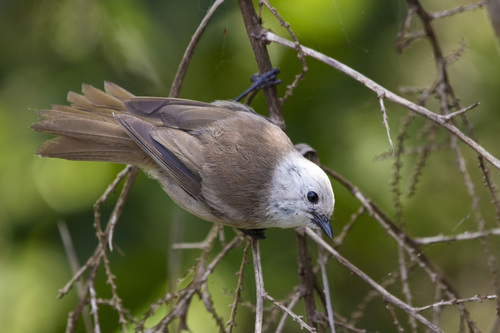
The whitehead (Māori name: pōpokotea), with the scientific name Mohoua albicilla, is a small passerine bird species endemic to New Zealand. It measures 15 cm in length, with an average weight of 18.5 g and 14.5 g, and is classified in the family Mohouidae. The male whitehead has pale brown upperparts, wings, and tail, with a white head and underparts that are almost pure white. Females and juveniles have similar coloration, but their nape and crown (top of the head) are shaded brown. Its black beak and eyes stand out against the white head, and its feet are bluish-black. Formerly quite common and widespread across native forests of New Zealand's North Island, the whitehead has experienced a marked decline over the past two centuries following European colonisation, and today it is limited to only a small fraction of its former range. Historically, deforestation destroyed large areas of this species' habitat, and currently the greatest threat to the whitehead is predation by invasive mammalian species such as rats and stoats. Active conservation work has been carried out for the species, and it has been successfully reintroduced to reserves near Auckland and Wellington. In Māori culture, the whitehead long held a special place. The species appears in many Māori legends, and Māori traditionally considered whiteheads to be messengers of the gods and fortune tellers or seers. Because of these beliefs, live whiteheads were caught and used in several different types of ceremonial rites. This species has always been restricted to the North Island of New Zealand and several surrounding offshore islands, including Little Barrier Island (where it is the most common forest bird), Great Barrier Island, and Kapiti Island. Its range has contracted sharply since the 19th century due to multiple human-caused factors. The whitehead and its closest relative, the yellowhead Mohoua ochrocephala, have allopatric distributions; the yellowhead is restricted to the South Island. Whiteheads are generally found only in remaining large tracts of older scrub and native forest in the North Island, but they have shown adaptability by establishing populations in several exotic pine plantations, particularly on the North Island Volcanic Plateau. Whiteheads live in flocks that are usually family groups. Unlike the yellowhead, which only nests in high tree trunk cavities in the forest canopy, the whitehead builds a typical cup-shaped nest 1 to 15 metres above the ground. The nest may be placed in the forest canopy or lower down in smaller trees or shrubs. Females lay between 2 and 4 eggs that vary in colour. Incubation generally lasts around 18 days, and chicks fledge 16 to 19 days after hatching. Both parents feed the chicks. In November and December, the long-tailed cuckoo (Urodynamis taitensis) often acts as a brood parasite for nesting whiteheads: it pushes the whiteheads' eggs out of their nest and lays one of its own eggs in the nest instead.