About Modiolus modiolus (Linnaeus, 1758)
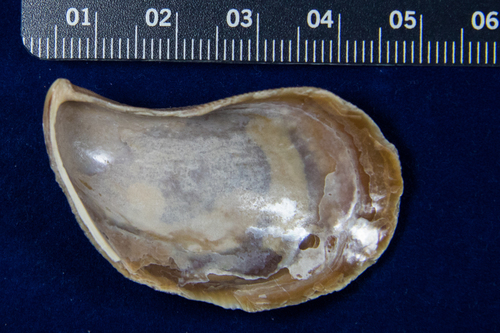
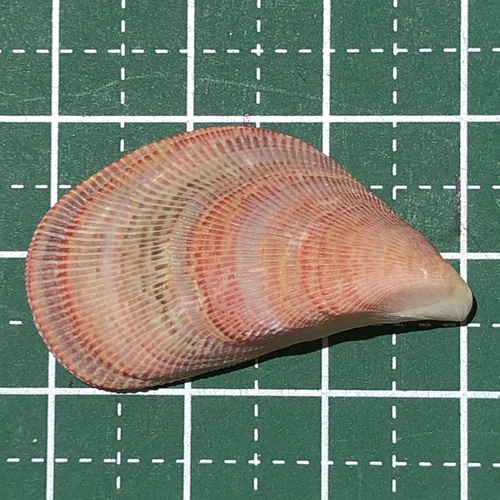
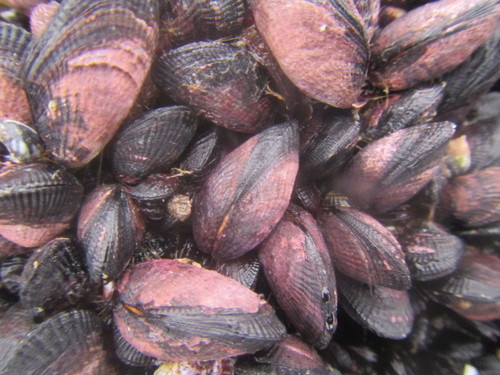
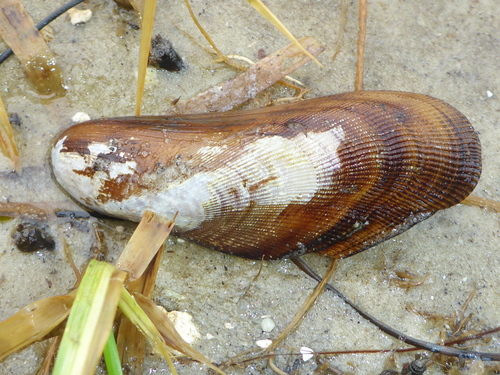
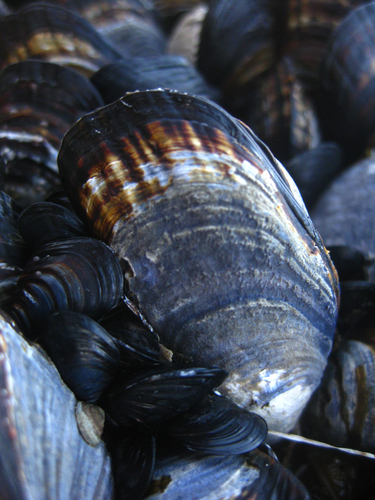
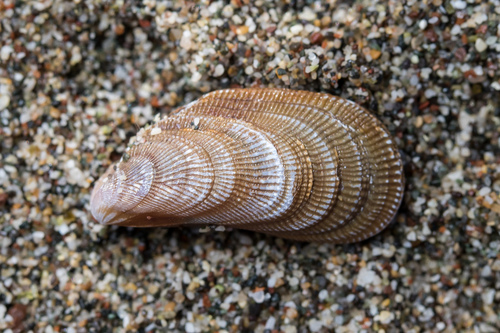
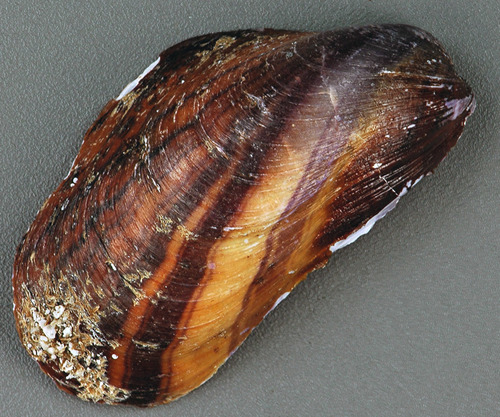
Modiolus modiolus is a large mussel species that can grow up to 22 centimeters (9 inches) in length, though 10 centimeters (4 inches) is a more typical adult size. Its shell is purplish or dark blue, thick and sturdy; young individuals have horny protuberances on their shells. The two shell valves are roughly triangular or bluntly oblong in shape, with rounded umbones positioned near the anterior end. Clear annual growth lines are visible on the shell, which also has fine sculpting made of concentric grooves and ridges. The interior of the shell is white, marked by a broad pallial line, a large anterior adductor muscle scar, and a smaller posterior adductor muscle scar. The soft body of this mussel is deep orange, and its mantle has no frill. The mussel attaches itself firmly to its substrate using byssus threads. Modiolus modiolus occurs along the Atlantic coast of North America ranging from the Arctic Ocean to Florida, and along the Pacific coast of North America ranging from the Arctic Ocean to California. It is also found on the Atlantic European seaboard from the United Kingdom northwards. In British waters, it lives from low tide mark down to 50 meters depth, while off the coast of Nova Scotia it can be found as deep as 80 meters. The largest bed of these horse mussels in Scotland is located near Noss Head in Caithness. Although the species is present in the Baltic Sea, it is classed as a vulnerable species there. Modiolus modiolus grows on hard substrates, including shells, stones, and the byssus threads of other mussels. Young individuals have very low survival rates, but once they reach approximately 4 centimeters long at 4 years of age, they are too large and tough to be preyed on by common predators such as the starfish Asterias rubens, the common whelk Buccinum undatum, and crabs. Juveniles that grow attached to other mussels' byssus threads have higher survival rates than free-living juveniles, and this pattern leads to the formation of cold-water mussel reefs. These reefs most often form in locations with fairly strong water currents. The species can tolerate low oxygen levels and reduced amounts of the phytoplankton that it feeds on. The boring sponge Cliona celata will sometimes damage the shells of older Modiolus modiolus individuals.