About Modiolus capax Conrad, 1837
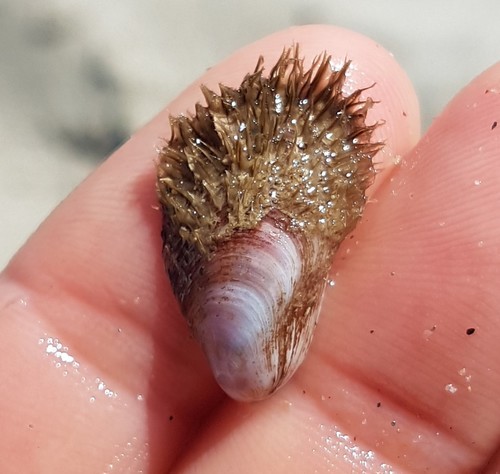
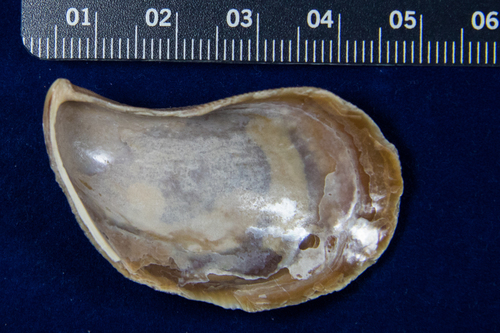
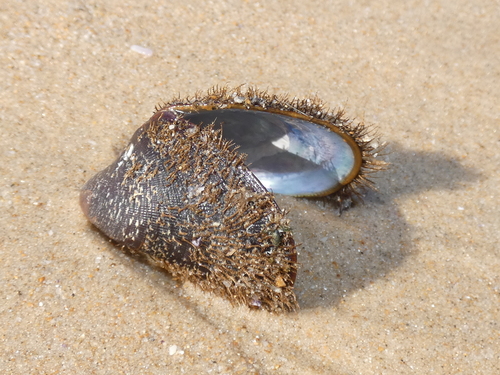
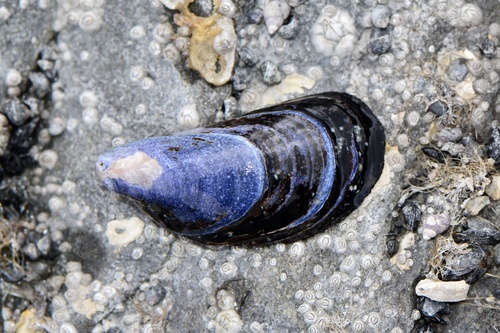
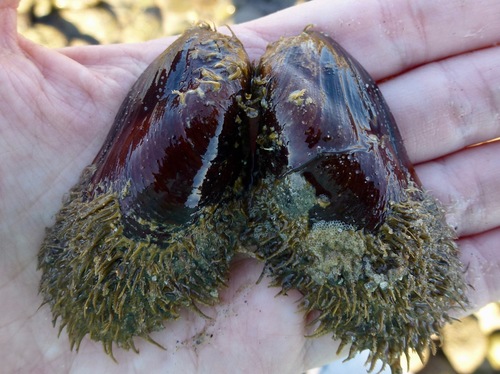
Modiolus capax Conrad, 1837, commonly called the fat horsemussel, has shells that reach approximately 81 millimetres (3.2 inches) in length, 40 millimetres (1.6 inches) in width, and 36 millimetres (1.4 inches) in diameter. Mature individuals can weigh up to 144.1 grams (5.08 ounces). This species has a noticeably variable overall form, but can always be identified by the serrate hairs covering its periostracum. Its left valve is more inflated than its right valve. The external surface of the shell ranges in color from blue to bright orange brown, while the inside of the shell is colored reddish-violet across the posterior half. This species is distributed from Santa Cruz, California, south to Playa, Peru, and is also found in the Galapagos Islands. It occurs throughout the entire Gulf of California. Fat horsemussels live in shallow water, ranging from the intertidal zone down to 25 fathoms. They attach to rocks, boulders, and pebbles on the seabed, and also attach to wooden pilings. Occasionally, individuals can be found partially buried in mud.