About Mocis undata (Fabricius, 1775)
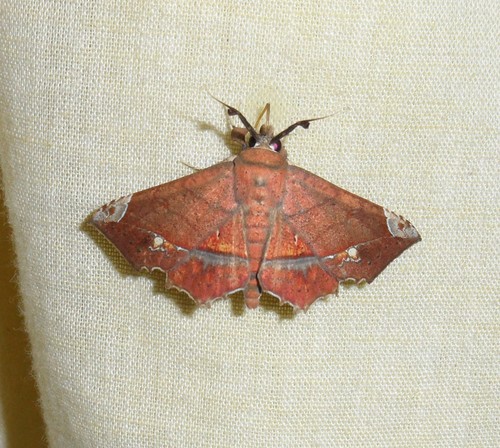
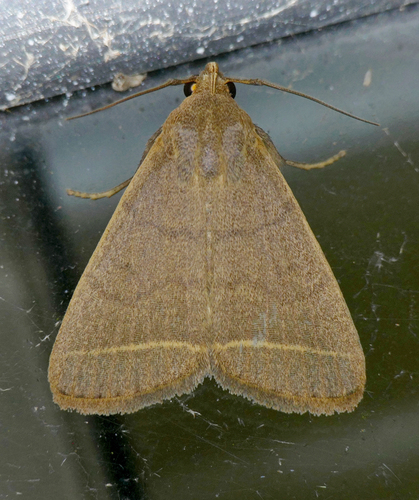
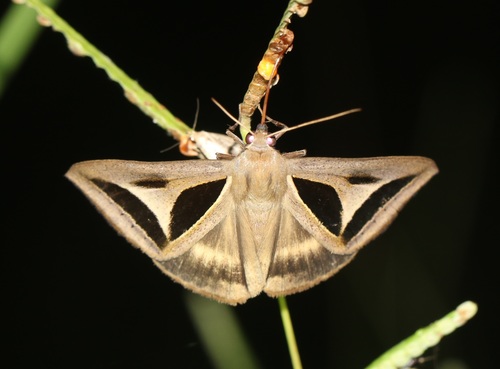
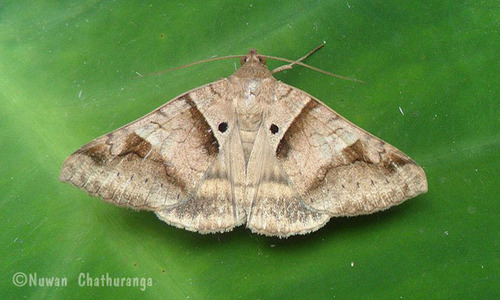
This moth species, Mocis undata (Fabricius, 1775), has the following physical characteristics. In adult males, the mid and hind tibiae are covered with long hair. The overall body is pale red-brown. The abdomen is pale fuscous, with an ochreous anal tuft. The forewing has a short sub-basal red-brown line. An oblique antemedial pale or ochreous line is present, with a diffused red-brown band along its outer edge. There is a sinuous medial line that is angled on the median nervure. The reniform spot is large and indistinct. A diffused red-brown postmedial band holds a dark line that curves slightly outwards beyond the cell; at vein 2, this dark line curves very irregularly inwards to the lower angle of the cell, then descends to the inner margin. An indistinct pale waved sub-marginal line is present, with a series of black specks along it. There is also a dark waved marginal line on the forewing. The hindwings are ochreous fuscous, with a narrow fuscous medial band and a diffused sub-marginal band. The legs are rufous. The larva is purplish brown, speckled with black. Its lateral area is yellowish, marked with red lines. A sub-lateral row of small black dots is present. The head is brownish, with a red lateral streak. The pupa is efflorescent. Known host plants for Mocis undata larvae include species from the genera Cytisus, Desmodium, Wisteria, Arachis, Butea, Cajanus, Calopogonium, Crotalaria, Derris, Glycine, Indigofera, Mucuna, Phaseolus, Pueraria, Rhynchosia, Tephrosia, Vigna, Shorea, Hevea, Gossypium, Nephelium, and Solanum.