About Mobula tarapacana (Philippi, 1892)
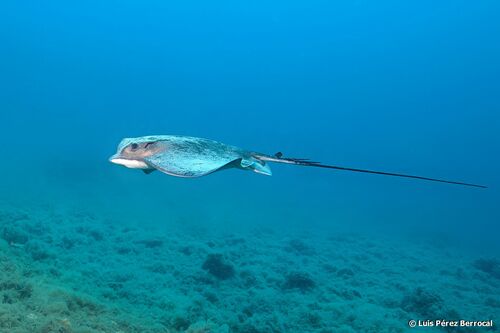
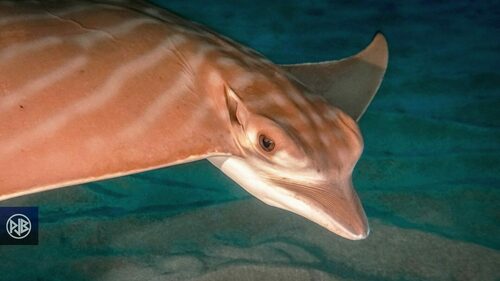
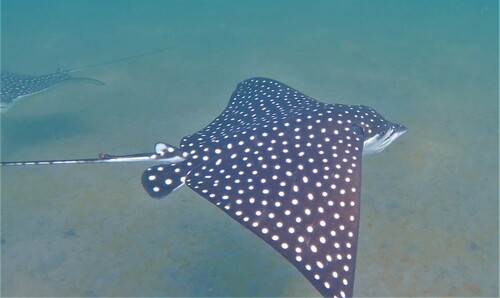
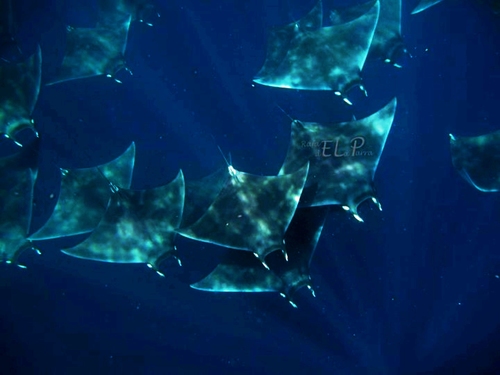
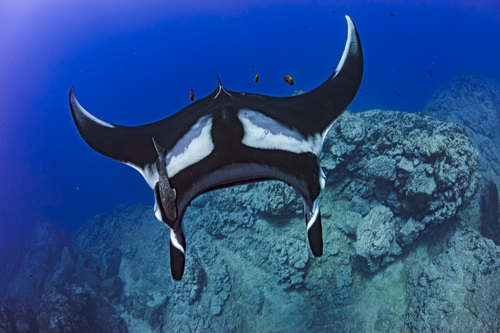
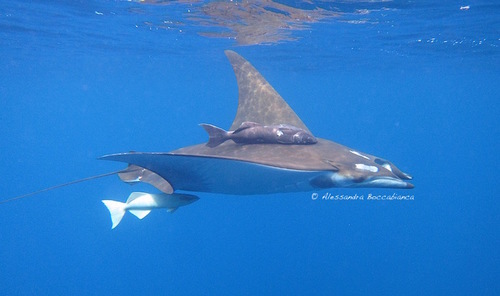
The Chilean devil ray, with the scientific name Mobula tarapacana, has several other common names: box ray, greater Guinean mobula, sicklefin devil ray, and spiny mobula. It is a species of ray that belongs to the family Mobulidae. This ray is often sighted across the globe, where it basks just beneath the surface of tropical, subtropical, and warm temperate oceans. It lives mainly offshore, and only occasionally appears near coastlines. It can grow to a maximum disc width of 3.7 metres, or 12 feet. Scientists originally thought the Chilean devil ray was only a surface-dwelling species, but individuals have now been recorded feeding during deep dives that reach depths of up to 1,896 metres, which is 6,220 feet. This species counts among the deepest-diving ocean animals. Dives by this ray very often follow a stepwise pattern: after diving to a great depth, the ray returns to the surface by repeatedly stopping at a constant depth for a period, then moving further upward. Sonar observations show that the rays stop at constant depths in regions with denser layers of prey, which indicates that this stepwise pattern is a foraging behavior. Chilean devil rays display two distinct deep-dive patterns. The stepwise dive pattern, which typically occurs only once every 24 hours, involves diving to maximum depth and returning to the surface between 60 and 90 minutes later. A second, less frequent pattern involves diving to depths of up to 1,000 metres, and can last a maximum of 11 hours. This second dive pattern may be linked to traveling rather than feeding. This ray's diving behavior may be connected to a specialized organ called the retia mirabilia. This organ is found in these rays, as well as in deep-diving great white sharks. It forms a veined network of blood vessels that warms the ray's brain when it is in colder deep waters. Before and after every deep dive, rays stay in warmer surface water for at least an hour, which suggests they absorb heat to prepare for their descent into cold water and recover from it afterwards.