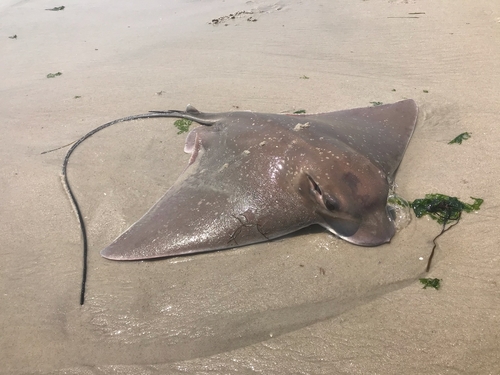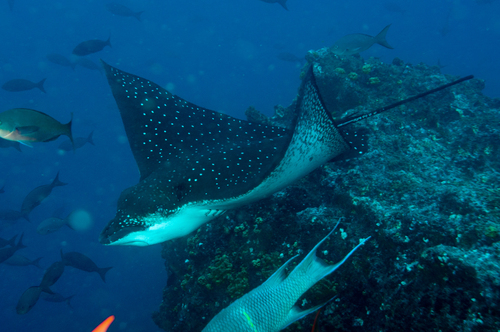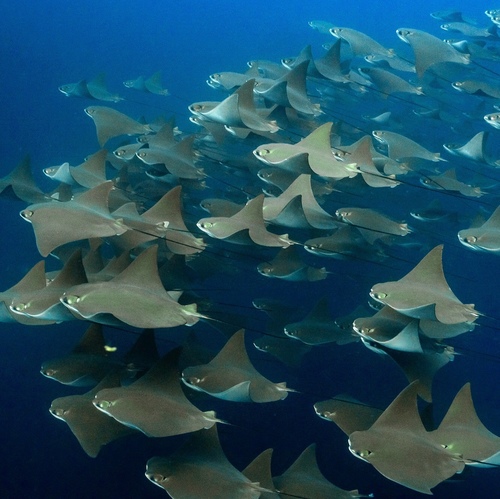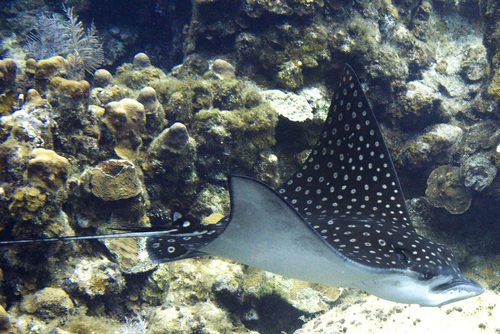
About Mobula munkiana Notarbartolo-di-Sciara, 1987
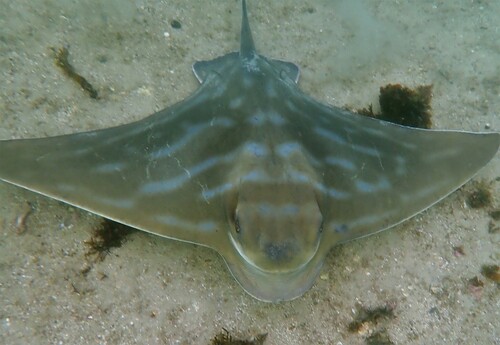
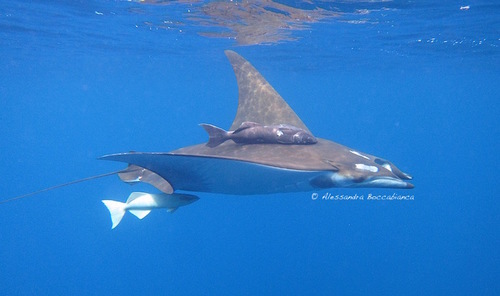
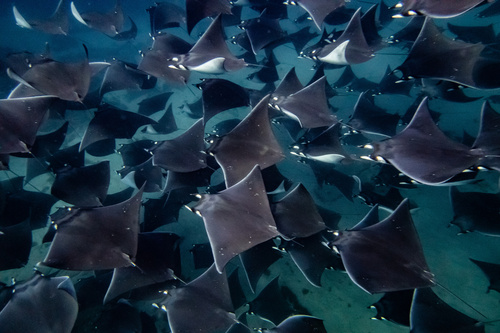
Mobula munkiana, commonly called the pygmy devil ray, is a member of the elasmobranch division Batomorphi. Pygmy devil rays are large fish with horizontally flattened bodies, bulging eyes on the sides of their heads, and gill slits located on their underside. On either side of their central body disc, they have wide, pointed pectoral fins that they use for swimming. A pair of fleshy lobes protrudes from the front of their heads, which helps funnel food into their mouths as they swim through water. This species has a small dorsal fin with a brownish to mauve-gray rim surrounding a lighter gray central area, a long and slender tail, and no caudal spine. The upper surface of the body ranges from lavender-gray to dark purple-gray, while the underside is white with gray tinging toward the tips of the pectoral fins. A dark gray collar-like stripe runs across the area near the head. This species can grow up to 1.1 metres (3.6 ft) wide, making it the smallest devil ray species, though it is only slightly smaller than M. hypostoma and M. kuhlii. Disc width can be used to determine the age of these rays: females under 97 cm and males under 98 cm are classified as neonates or juveniles. Neonates can be told apart from older juveniles by the presence of an umbilical cord scar. Mobula munkiana is found in tropical regions of the eastern Pacific Ocean, with a range extending from the Gulf of California to Peru, including near offshore islands such as the Galapagos, Cocos, and Malpelo. They are most often found in coastal waters near the surface or the seabed, typically forming schools, though they may also occur alone or in small groups. They spend most of their time at the sea surface in open ocean areas, where food sources are most abundant. During reproductive season in shallower waters, they tend to stay near the seabed, where food gathers on the bottom. Mobula munkiana is suspected to be a migratory species, but its migratory movements are poorly understood, and they may be linked to changes in surface water temperature. Mobula munkiana has a distinct mating ritual called the "courtship vortex." During this ritual, individuals move in a clockwise direction for hours, with mating groups entering and exiting the vortex. This process is thought to allow individuals to assess potential mates before interacting one-on-one. Once a male identifies a female he is interested in, he attempts to bite her pectoral fin — this is a common elasmobranch mating behavior that signals mating intent. Females can reject unwanted advances by curving their pectoral fins above their heads. These reproductive behaviors typically occur between March and August, with a peak in activity in May. This species is ovoviviparous, meaning eggs hatch inside the mother's body. Only one egg is produced per reproductive cycle, giving this species a far lower birth rate than many other elasmobranch species. Because of their low fecundity, the species uses a histotrophy reproductive strategy to properly support the developing egg. The single developing young is first nourished by the egg yolk, and later receives nutrients from the uterine fluid that surrounds it. While this process delivers necessary nutrients to the embryo, excess unwanted nutrients can cause problems, leading to developmental defects or irregular growth that harms both the mother and the embryo. When born, newborn rays measure between 35 and 43.3 cm wide. Warmer temperatures after birth increase a juvenile's chance of survival, as these temperatures are thought to accelerate juvenile metabolism and growth, reducing the length of time juveniles remain in a vulnerable life stage. For this reason, infants and juveniles are almost always found in warm shallow coastal habitats.