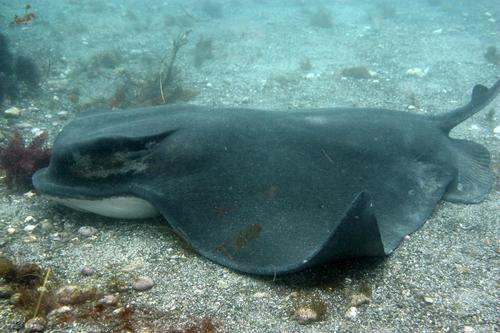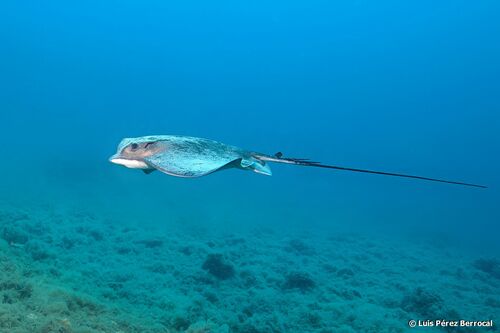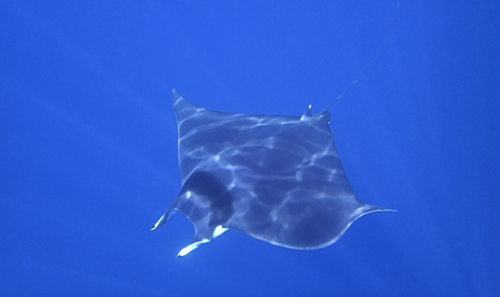
About Mobula mobular (Bonnaterre, 1788)
The scientific name of the devil fish (also called giant devil ray) is Mobula mobular (Bonnaterre, 1788).
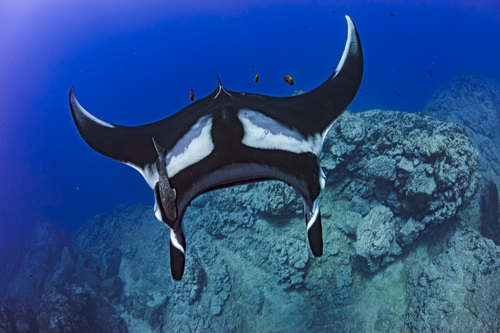
Description: The devil fish is larger than its close relative the lesser devil ray. It grows to a disk length of 3.5 metres (11 ft), making it one of the largest rays. It has a spiny tail, and is considered the only devil fish with a tail spine. It ranks as the third largest species in the genus Mobula, after the oceanic manta ray and reef manta ray. It is the only mobulid species that lives in the Mediterranean Sea. There is a claimed maximum recorded disk width of 5.2 meters (roughly 17 feet), but this data is unreliable, and it is alleged that the measurement was mistakenly taken from giant oceanic manta rays that strayed into the Mediterranean.
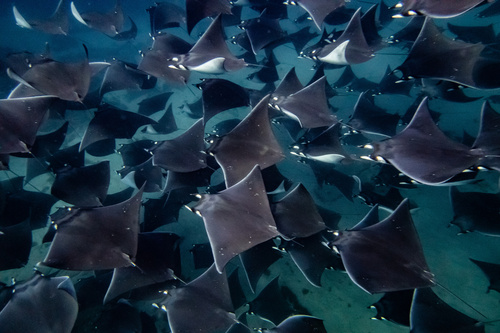
Distribution and habitat: The devil fish is most common in the Mediterranean Sea, where it has a basin-wide distribution, and is most frequent in the eastern Mediterranean and the Adriatic Sea. Large aggregations observed in the Levantine basin may signal an important mating area. It is also found in the Eastern Atlantic Ocean off the southwest coast of Ireland and south of Portugal, as well as in the central and western Pacific Ocean. Devil fish inhabit offshore areas down to the neritic zone, with their range reaching as deep as several thousand meters. They are typically observed in small clusters, and may occasionally form larger groups. Giant devil rays are usually seen in deep coastal waters but are occasionally seen in shallow waters. A tagging experiment conducted by the Italian National Institute for Environmental Protection and Research (ISPRA) tagged three giant devil rays and tracked their depth throughout different times of day. The rays reached a maximum depth of 600–700 meters (2,000–2,300 ft) but mostly spent their time between 0 and 50 meters (0 and 164 ft). They prefer warmer waters with a temperature between 20 and 29 °C (68 and 84 °F). Unlike other species that deep dive at specific times of day, giant devil rays deep dive at random times unrelated to the time of day. Other observations studying ray abundance and habitat found giant devil rays can be seen alone and occasionally in groups with a maximum of 18 rays. The same study also notes that the rays undergo seasonal migration across the Mediterranean Sea, taking advantage of warm, highly productive waters.
Ecology: The average lifespan of a giant devil ray is 20 years. It is an epipelagic species with very low reproductive capacity. It gives birth to a single offspring per pregnancy, at unknown intervals. The species is ovoviviparous: the young hatch from their eggs inside the mother's body and emerge later when they are more fully grown. The disc width of a pup born at the Osaka Aquarium was 1.03 m (3 ft 5 in). Based on its current population decline rate, it is predicted that the population will decline by at least 50% in the next 60 years, due to multiple threats including the species' low likelihood of recovering from population decline. Devil rays feed on planktonic crustaceans and small schooling fish, which are funneled into the mouth with cephalic flaps. When these flaps are rolled up, they look like horns, giving the animal a "devil-like" silhouette. It mostly eats northern krill (Meganyctiphanes norvegica) and small mesopelagic and clupeid fishes.