About Mobula birostris (Walbaum, 1792)
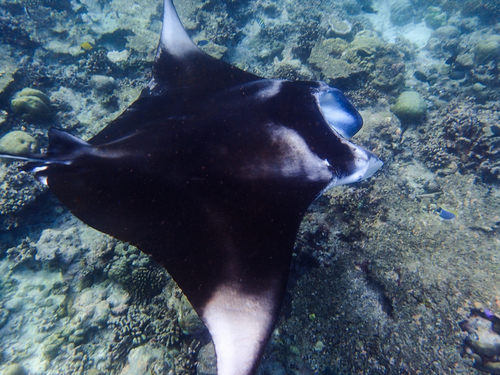
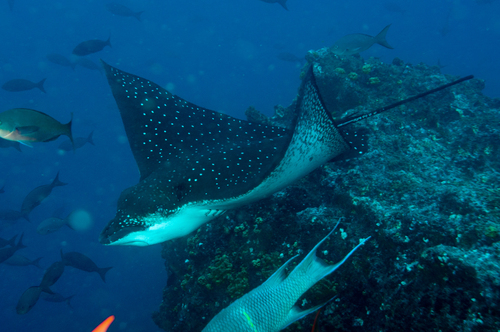
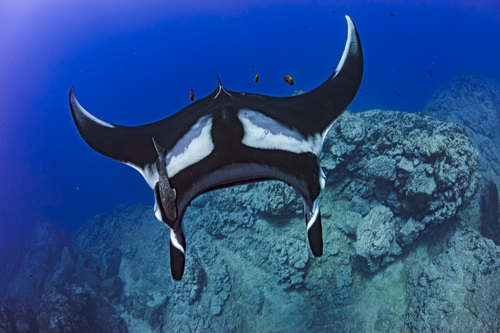
Mobula birostris, the giant oceanic manta ray, can reach a maximum length of 9 m (30 ft), a maximum disc width of 7 m (23 ft), and a maximum weight around 3,000 kg (6,600 lb), with a more typical length of 4.5 m (15 ft). Its body is dorsoventrally flattened, with large triangular pectoral fins positioned on either side of its body disc. A pair of cephalic fins, forward extensions of the pectoral fins, sits at the front of the body. These fins can be rolled into a spiral when the ray is swimming, or flared out to channel water into its large, forward-pointing rectangular mouth during feeding. Its teeth are arranged in a band of 18 rows, and are restricted to the central part of the lower jaw. The eyes and spiracles are located on the sides of the head, behind the cephalic fins, and the gill slits sit on the ventral (under) surface. It has a small dorsal fin and a long whip-like tail. Unlike closely related devil rays (Mobula spp.), the giant oceanic manta ray does not have a spiny tail; instead, it has a knob-like bulge at the base of the tail. Its skin is smooth, with scattered conical and ridge-shaped tubercles. The dorsal (upper) surface is colored black, dark brown, or steely blue, sometimes with a few pale spots, and usually has a pale edge. The ventral surface is white, sometimes marked with dark spots and blotches. These unique markings are often used to identify individual manta rays. This species has a widespread distribution across tropical and temperate waters worldwide. In the Northern Hemisphere, it has been recorded as far north as southern California and New Jersey (United States), Aomori Prefecture (Japan), the Sinai Peninsula (Egypt), and the Azores (northern Atlantic). In the Southern Hemisphere, it occurs as far south as Peru, Uruguay, South Africa, and New Zealand. It is an ocean-going species that spends most of its life far from land, traveling with currents and migrating to areas where nutrient-rich upwellings increase zooplankton availability. Giant oceanic manta rays are often found associated with offshore oceanic islands. Males reach sexual maturity when their disc width is approximately 4 m (13 ft), while females require a disc width of about 5 m (16 ft) to breed. When a female becomes receptive, one or multiple males may swim behind her in a formation called a "train". During copulation, one male grips the female's pectoral fin with his teeth, and the pair continues swimming while their ventral surfaces remain in contact. The male inserts his claspers into the female's cloaca; the claspers form a tube through which sperm is pumped. The pair stays coupled for several minutes before separating. Fertilized eggs develop inside the female's oviduct. Initially, embryos are enclosed in an egg case and get nutrition from the yolk. After the egg hatches, the pup remains in the oviduct and receives nourishment from a milky secretion. Because there is no placental connection between the pup and its mother, the pup uses buccal pumping to obtain oxygen. Brood size is usually one, though occasionally two embryos develop at the same time. The gestation period is thought to be 12 to 13 months. When fully developed, the pup has a disc width of 1.4 m (4 ft 7 in), weighs 9 kg (20 lb), and already resembles an adult. Pups are expelled from the oviduct, usually near the coast, and stay in a shallow-water environment for the first few years of life as they grow. Females only reproduce every two to three years. The species' long gestation periods and slow reproduction rates make it highly vulnerable to population changes.