About Mobula alfredi (Krefft, 1868)
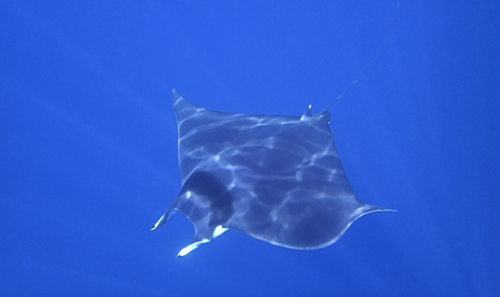
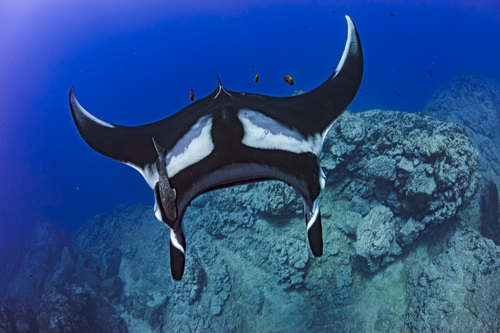
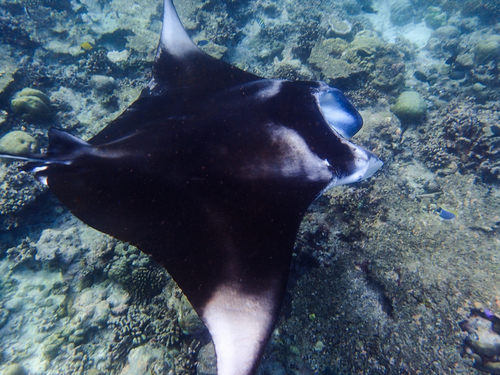
Mobula alfredi, commonly known as the reef manta ray, reaches a maximum disc size of up to 5 meters (16 feet), while the average size commonly seen in the wild is 3 to 3.5 meters (11 feet). It has a dorsoventrally flattened body, with large triangular pectoral fins positioned on either side of its body disc. A pair of cephalic fins, forward extensions of the pectoral fins, sit at the front of its body. These cephalic fins can be rolled into a spiral when the ray is swimming, or flared open to direct water into its large, forward-facing rectangular mouth during feeding. The species’ eyes and spiracles are located on the sides of the head, behind the cephalic fins, and five gill slits sit on its ventral (under) surface. It has a small dorsal fin and a long, whip-like tail. Unlike its close relatives the devil rays (other Mobula spp.), reef manta rays do not have a spiny tail. The dorsal side of the body ranges in color from dark black to midnight blue, with scattered whitish and greyish patches on the upper surface of the head. The ventral surface is white, and sometimes marked with dark spots and blotches. These unique markings are often used to identify individual reef manta rays. Mobula alfredi looks very similar to Mobula birostris, and the two species are often confused because their geographic ranges overlap, though they do have distinct distinguishing features. The reef manta ray has a wide distribution across tropical and subtropical regions of the Indo-Pacific. There are very few records of the species from the warm East Atlantic, and no records from the West Atlantic or East Pacific. It is regularly sighted in many frequently visited regions including Hawaii, Fiji, French Polynesia, Micronesia, Bali, Komodo, the Maldives, Mozambique, Australia, and the Philippines. The species is primarily found in coastal regions. Reef manta rays generally occupy a consistent large home range, and may only make short migrations to follow zooplankton food sources. As a result, they have relatively sedentary behavior, with specific cleaning and feeding sites that remain close to coasts, reefs, or islands.