About Mniotilta varia (Linnaeus, 1766)
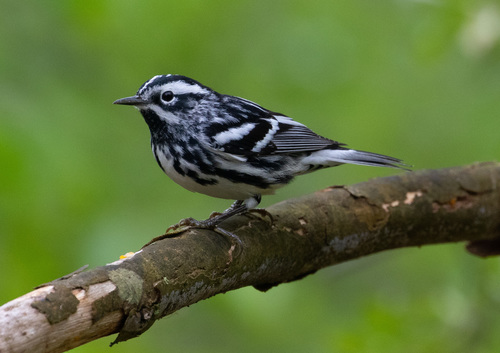
The black-and-white warbler (Mniotilta varia) measures 11 cm (4.3 in) to 13 cm (5.1 in) in length, weighs between 8 g (0.28 oz) and 15 g (0.53 oz), and has a wingspan ranging from 18 cm to 22 cm (7.1 in to 8.7 in). An average individual is 12 cm (5 in) long and weighs 11 g (0.39 oz). True to its common name, this species has an overall black and white plumage. Both sexes share common markings: a black and white crown with a white eyebrow, black streaking on a white belly, black wings marked with two white wing bars, a black tail, a black and white streaked back, streaky undertail coverts, and grey-black legs and feet. Breeding males have a black-and-white streaked throat and black cheek, while females have a grey cheek with a white-cream coloured throat and sides. First fall males are very similar in colour and patterning to adult females. First fall females also resemble adult females, but have less streaking and a more noticeable buffy wash. Juveniles are heavily spotted, but are otherwise similar to first fall individuals. Summer breeding males are boldly streaked in black and white, and have been described as a flying humbug. Female and juvenile plumages are similar to each other, but are duller and less streaky than adult breeding males. This species can be confused with other warblers. It is often mixed up with the blackpoll warbler (Setophaga striata), which is also black and white in summer plumage but has a solid black cap. It can also be confused behaviourally with the pine warbler (Setophaga pinus) and yellow-throated warbler (Setophaga dominica).
The black-and-white warbler breeds across northern and eastern North America. Its breeding range extends from the Northwest Territories in the northwest and Newfoundland and Labrador in the northeast, south to North Carolina in the southeast and Texas in the southwest. This is a fully migratory species; it winters in Florida, Central America, the West Indies, and northern South America as far south as Peru. The IUCN estimates the species’ total extent of occurrence is 11,500,000 km². It occurs as a vagrant in Iceland, Ireland, the Faroe Islands, and the United Kingdom. Within its breeding range, it is typically found in deciduous forest, and it prefers mature forest though it will also occupy successional and second growth forest. Preferred forest types include deciduous and mixed forest, and it sometimes lives in swampy forest. During migration, it prefers forest over other land cover types and is frequently found in riparian areas. In its wintering range, it is a habitat generalist that occupies a broad niche and can be found in a wide variety of land cover types, including mangroves, wet forest, dry forest, cloud forest, both successional and mature forest, shade coffee plantations, and gardens. Males are territorial in both their summer breeding and winter non-breeding habitats.
The black-and-white warbler feeds on insects and spiders; unlike most other warblers, it forages in a nuthatch-like manner, moving up and down tree trunks and along branches, with foraging behaviour similar to both nuthatches and creepers. It forages on tree trunks and large limbs to reach insects below the bark surface. Its short legs and long hind toe are physical adaptations suited to this foraging method. It is unique among warblers for how much time it spends foraging on tree trunks and inner branches. It also gleans insects from foliage like many other warbler species. Its full diet is made up of insects and other arthropods, including lepidopteran larvae, beetles, ants, and spiders. During migration and the breeding season, this warbler relies heavily on lepidopteran larvae. During migration, it will sometimes join mixed-species foraging flocks.