About Mnemiopsis leidyi A.Agassiz, 1865
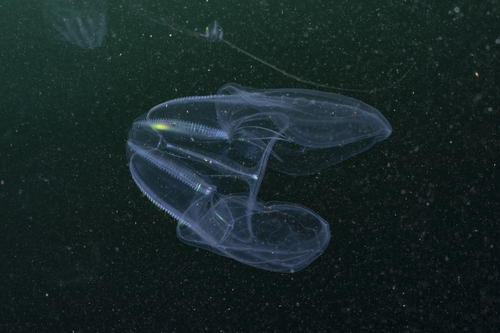
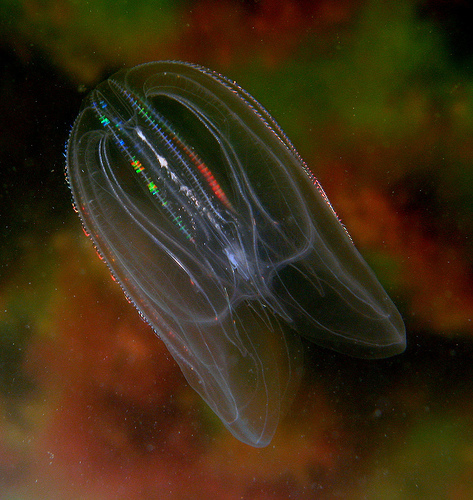
Mnemiopsis leidyi, commonly called the sea walnut due to its slow movement, has an oval, transparent, lobed body. It has eight vertical rows of ciliated combs along its body that glow blue-green when disturbed, plus several feeding tentacles. Unlike cnidarians, this species does not sting. Its body is 97% water, reaching a maximum length of roughly 7 to 12 centimetres (3 to 5 inches) and a diameter of 2.5 centimetres (1 inch). This species is euryoecious, meaning it tolerates a wide range of salinity (2 to 38 psu), temperature (2–32 °C or 36–90 °F), and water quality. Mnemiopsis leidyi is a carnivore that feeds on zooplankton, including crustaceans, other comb jellies, and fish eggs and larvae. Its predators include vertebrates such as birds and fish, plus gelatinous zooplankton including Beroe ctenophores and various Scyphozoa (true jellyfish). Mnemiopsis leidyi is hermaphroditic and capable of self-fertilization. Its gonads, which hold ovary and spermatophore clusters, are located in its gastrodermis. Each of its meridional canals carries 150 eggs. Eggs and sperm are released into open water for fertilization. Spawning occurs in late evening or between 1:00 and 2:00 a.m. Spawned eggs develop a thick outer layer within one minute of contact with seawater. Large specimens in prey-rich areas can produce as many as 10,000 eggs. Egg production begins when individuals reach about 15 mm in length, and increases as the ctenophore grows larger; when senescence occurs remains unclear. Like the so-called immortal jellyfish, Mnemiopsis leidyi can undergo reverse development, meaning it can revert to an earlier life cycle stage. A 2024 description confirmed that this species is biologically immortal via this reverse development, shifting from a mature lobate stage back to an early cydippid stage after sexual reproduction begins. This makes it the only species known from the phylum Ctenophora with this ability, which was previously recorded only in cnidarian jellyfish such as Turritopsis dohrnii. Mnemiopsis leidyi has a transient anus that only appears during defecation, with no permanent connection between its gut and the rear of its body. As waste accumulates, a portion of the gut balloons outward until it touches the outer epidermal layer. The gut then fuses with the epidermis to form an anal opening. After excretion is complete, the process reverses and the anus disappears. Individuals defecate on a regular schedule: once an hour for 5-centimetre-long adults, and roughly once every 10 minutes for larvae.