About Mixophyes iteratus Straughan, 1968
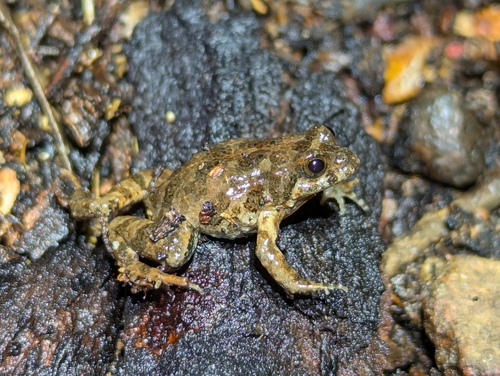
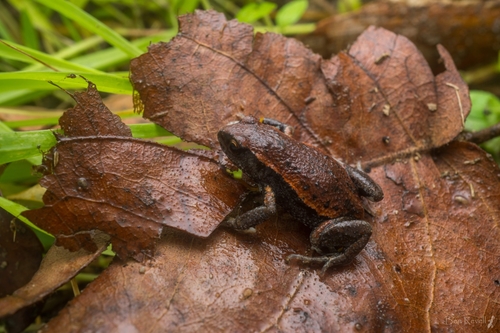
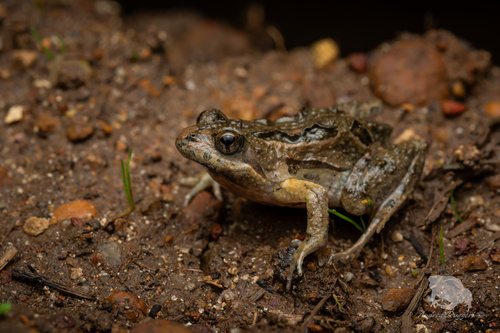
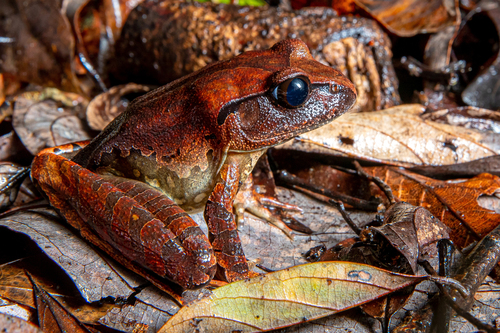
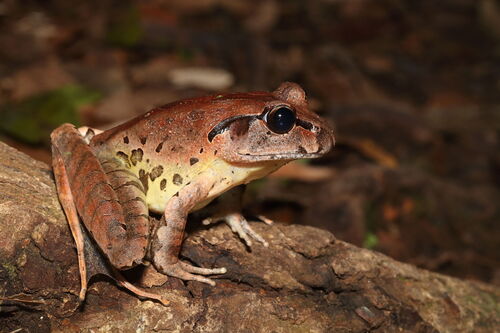
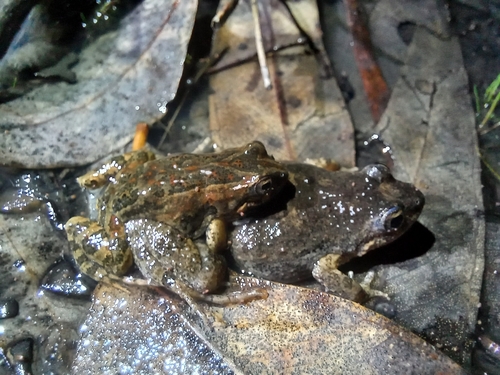
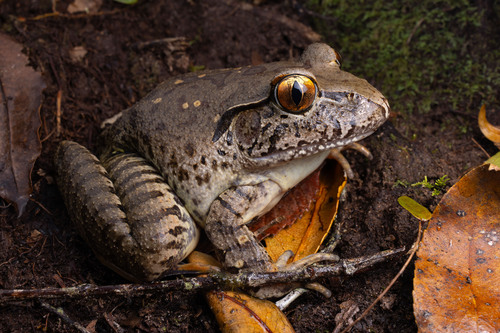
Mixophyes iteratus Straughan, 1968 is Australia’s second largest frog species, reaching a maximum size of approximately 120 millimetres (4.7 in). Its dorsal surface is normally dark brown, marked with darker spots of varying sizes. The upper half of its iris is golden, while the lower half is darker. A thin dark stripe runs from the snout, through the eye, and continues down past the tympanum. A dark triangular marking sits at the tip of the snout, starting from the nostril; a paler triangle lies behind this marking, stretching back to the eye. Its legs have prominent strong barring, and its toes are fully webbed. The thighs and flanks are a distinct pale yellowish color, with many darker spots present in this area. Its underbelly is white.
This species is always found near water, most commonly along permanent flowing creeks, but will sometimes also occupy dams within wet sclerophyll forest and rainforest. Its call is a deep grunting noise. Males call from stream edges during spring and summer, after rain. During amplexus, the female kicks eggs up onto an overhanging bank or rock. The eggs stick to this surface until heavy rain washes them into the water; if no heavy rain occurs to wash the eggs into water, the tadpoles simply fall into the water 8 to 10 days after laying. The tadpoles of this species grow very large, reaching up to 84 mm, and are among the largest tadpoles found in Australia.