About Mixophyes fasciolatus Günther, 1864
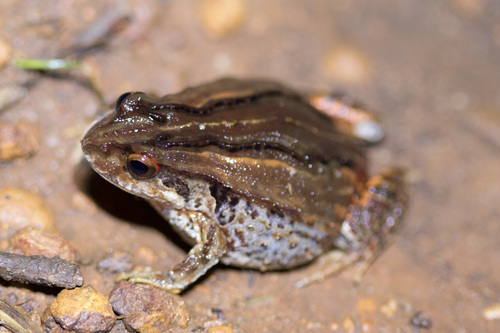
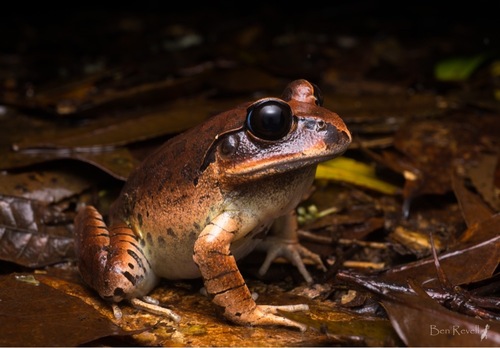
The great barred frog, scientifically known as Mixophyes fasciolatus Günther, 1864, reaches 8 centimeters in size and has large, powerful legs. Its dorsal surface is dark brown, while its ventral surface is white. Its thighs are yellow with black blotches, and parallel black bars run along its legs. A distinct dark line starts at the snout, runs through the eye and over the tympanum, then bends downward behind the tympanum. All toes on its feet are fully webbed, while the fingers of its hands have no webbing at all. Its eyes sit on top of the head, and the tympanum is clearly visible. This species produces very large tadpoles that grow up to 8.5 centimeters in length, which are grey-brown or gold-brown in color. This is a ground-dwelling frog that lives in rainforests, Antarctic beech forests, and wet sclerophyll forests. Unlike all other species in the genus Mixophyes, which only breed in streams, the great barred frog breeds in both streams and ponds. It calls from the land surrounding these breeding sites. Its mating call is a very loud repeated "wark-wark-wark", which is occasionally followed by softer, slow repeated trills of "bwaaark-bwaaark". Males and females enter the water to engage in amplexus. After laying eggs, the female flicks them onto the nearby bank to develop. The first rain event washes these eggs into the stream or pond, where they hatch into tadpoles. Tadpoles take approximately 12 months to develop into adult frogs. Great barred frogs are almost always found near running water. Their powerful legs and webbed feet let them escape predators by hopping long distances into water and swimming away quickly.