About Mitragyna parvifolia (Roxb.) Korth.
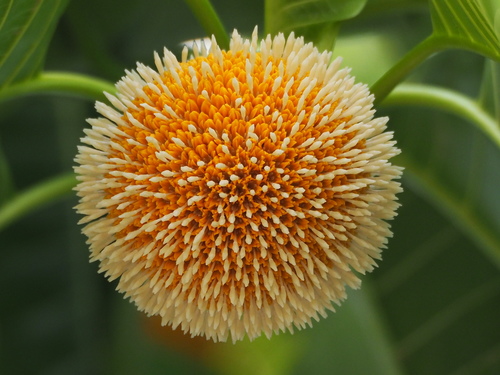
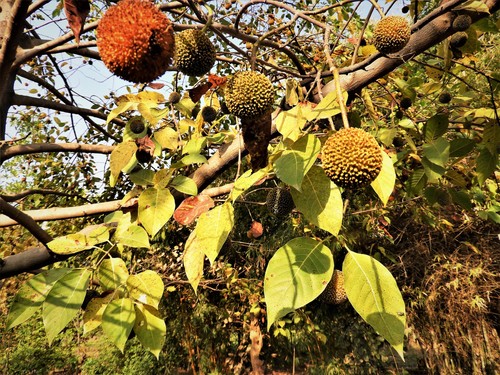
Mitragyna parvifolia (Roxb.) Korth. is a tree species native to India and Sri Lanka in Asia. Throughout the regions where Mitragyna species grow, they are used for medicinal purposes and for their fine timber. M. parvifolia grows to 50 feet in height, with a branch spread of more than 15 feet. Its stem is erect and branching. This species produces yellow flowers that grow in ball-shaped clusters. Its leaves are dark green, smooth, rounded in shape, and grow in an opposite arrangement. In traditional medicine, fresh leaf sap of Mitragyna parvifolia is used by several tribal groups of Gundur District, Andhra Pradesh—the Chenchus, Yerukalas, Yanadis and Sugalis—to treat jaundice. Its leaves relieve pain and swelling, and are used to support better healing of wounds and ulcers. Local inhabitants of Tumkur district, Karnataka, India use its stem bark to treat biliousness and muscular pains. Tribal people of Sonaghati in Sonbhadra district, Uttar Pradesh use a decoction of M. parvifolia bark to heal fever. The Valaiyans tribe living in the Sirumalai hills of Madurai district, Western Ghats, Tamil Nadu use the stem bark to treat rheumatic pain. The bark and roots of this species are used to treat fever, colic, muscular pain, burning sensation, poisoning, gynecological disorders, cough, and edema, and are also used as an aphrodisiac. Its fruit juice increases breast milk production in lactating mothers, and also acts as a lactodepurant. Caterpillars of the commander butterfly (Limenitis procris), a brush-footed butterfly, use this species as a food plant.