About Mitoura gryneus (Hübner, 1816)
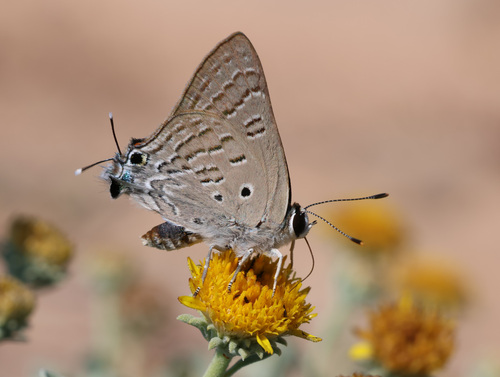
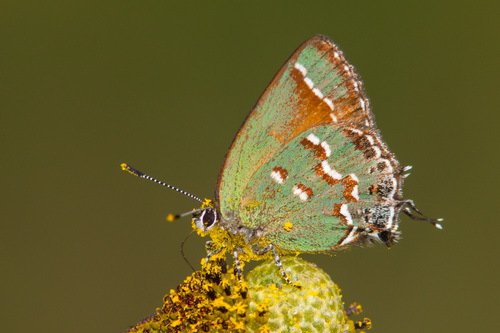
Mitoura gryneus, commonly called the juniper hairstreak, has many described subspecies, some of which may actually be separate species. The nominate subspecies, the olive juniper hairstreak (M. g. gryneus), has an upper wingside that is tawny orange or bronzy in males and blackish brown in females. Its underside of the wings is bright green with variable amounts of brown scaling. On the hindwing, there are two white postbasal spots and a white zigzag postmedian line edged inward with brown. Sweadner's juniper hairstreak (M. g. sweadneri) is very similar to the nominate gryneus race, except its two white postbasal spots are reduced. The Siva juniper hairstreak (M. g. siva) is also similar to gryneus, but it has no postbasal spots, its postmedian line is straight, and some individuals are brown. Intermediates between the gryneus and siva races are found in west Texas and New Mexico. Nelson's juniper hairstreak (M. g. nelsoni) has a brown wing underside with a violet sheen; its white postmedian line is faint, and may sometimes be partial or entirely absent, and it lacks postbasal spots. Muir's juniper hairstreak (M. g. muiri) is similar to the nelsoni race, except its wing underside is a darker brown with a purplish-greenish tint, and its postmedian line ranges from partial to complete. The Loki juniper hairstreak (M. g. loki) has a wing underside that ranges from green to purplish brown. Inward from the white postmedian line, the hindwing often has a dark band. Thorne's juniper hairstreak (M. g. thornei) is quite similar to the loki race, except it usually lacks green tint, and most often is violet brown to brownish gray. This butterfly lives in habitats including bluffs, open fields, barrens, and dry or rocky open areas. It is almost always found near or on juniper plants within these habitats. During its life cycle, males are highly territorial on cedar trees, where they perch to search for females. Gently shaking cedar trees will often flush resting males into flight. Females lay their eggs singly on the tip of host plant leaves. The eggs are pale green with white ridges. Larvae are vivid green, with a faint middorsal stripe that starts at the thorax and extends down the abdomen. Whitish-yellow spots sit on either side of the middorsal stripe, and a whitish-yellow subspiracular stripe that is sometimes broken between segments runs the full length of the body. The chrysalis of the gryneus race is brown to pale brown, mottled with black, and has a slightly reddish abdomen. Chrysalids of western races are dark brown. The juniper hairstreak overwinters in the chrysalis life stage. Different subspecies have different numbers of annual broods: the gryneus and sweadneri races have two broods per year; the siva race has two or three broods per year; the nelsoni, muiri, and thornei races each have one brood per year; and the loki race has one or two broods per year.