About Mitchella repens L.
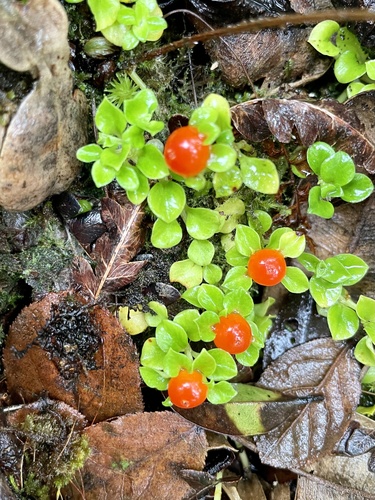
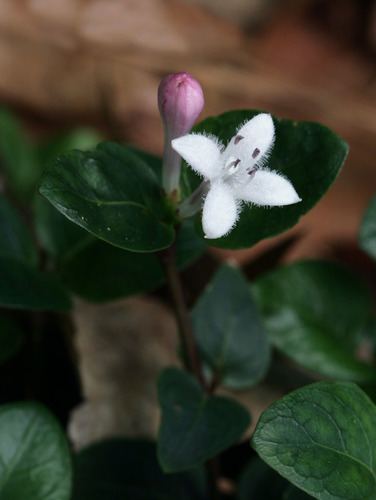
Mitchella repens L., commonly called partridge berry, is an evergreen non-climbing creeping vine that reaches no more than 6 cm in height, with creeping stems between 15 and 30 cm long. Its evergreen leaves are dark green and shiny, shaped from ovate to cordate, with a pale yellow midrib. Leaves are borne oppositely in paired arrangements on short petioles. Adventitious roots may grow at stem nodes, and rooting stems can branch and root repeatedly to form loose spreading mats. Small, trumpet-shaped axillary flowers grow in pairs, with each pair arising from a single common calyx covered in fine hairs. Each flower has four white petals, one pistil, and four stamens. Partridge berry is a distylous species: individual plants produce flowers that are either long-styled (pins) with long pistils and short stamens, or short-styled (thrums) with short pistils and long stamens. These two style morphs are genetically controlled, and pollen from one morph cannot fertilize the other, creating heteromorphic self-incompatibility. The ovaries of the paired twin flowers fuse together, so each berry develops from two flowers; the two bright red spots on each berry are vestiges of this fusion process. Fruit ripens between July and October, and may persist through the winter. The fruit is a drupe that holds up to eight seeds. Fruits are never produced in large quantities. They are eaten by several birds including ruffed grouse, sharp-tailed grouse, northern bobwhite, and wild turkey, and also consumed by foxes, white-footed mice, and skunks. White-tailed deer occasionally eat the foliage. This species most commonly reproduces vegetatively, with plants forming large spreading colonies. This species is distributed across eastern North America, ranging from southeastern Canada south to Florida and Texas, and extending south to Guatemala. It grows in dry or moist woods, along stream banks, and on sandy slopes. Mitchella repens is cultivated for its ornamental bright red berries and shiny, bright green foliage. It is grown as a creeping ground cover for shady locations. It is rarely propagated from seed for garden use, but propagation from cuttings is easy. Plants have been widely collected for use in Christmas decorations, and overcollection has negatively impacted some local populations. The plants are also sometimes grown in terrariums. The scarlet berries are edible but mostly tasteless, with a faint wintergreen flavor that resembles cranberries, though the two are not closely related. Indigenous American women prepared a tisane from the plant's leaves and berries that was drunk during childbirth; the Menominee people used the leaves to make a drink that treated insomnia. Traditionally, the plant had many medicinal uses: it was used as a diuretic by the Cherokee and Iroquois peoples, as a diaphoretic by the Cherokee, to treat women's health and reproductive issues by the Cherokee, Delaware, and Iroquois peoples, and as an analgesic or to reduce fever and swelling by the Abenaki, Iroquois, and Montagnais peoples.