About Misumena vatia (Clerck, 1757)
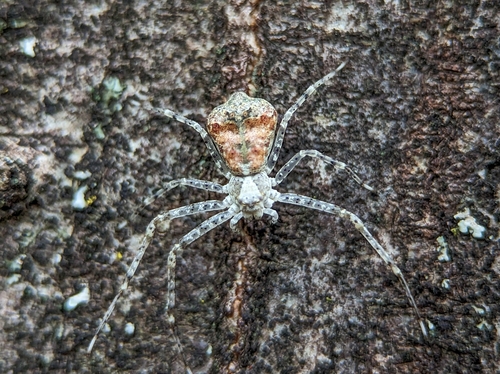
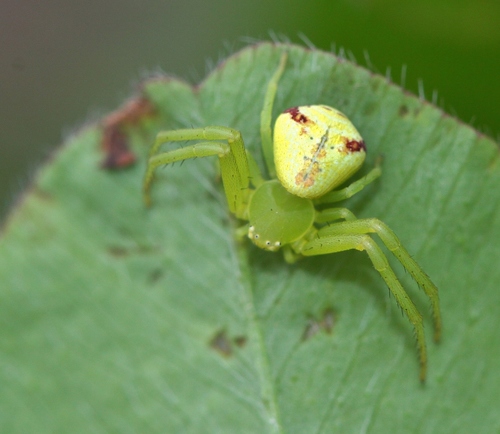
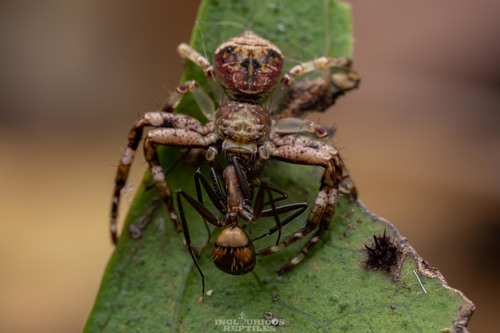
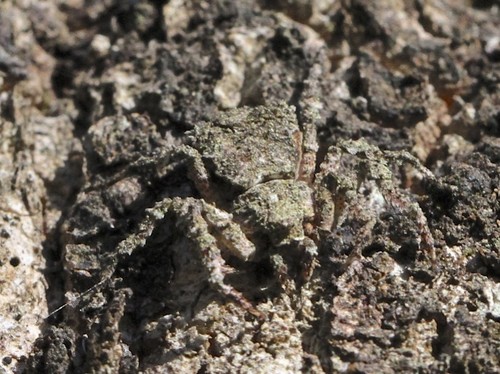
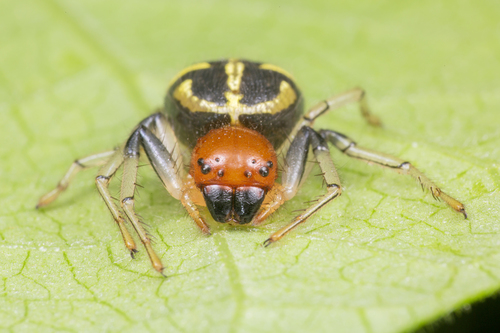
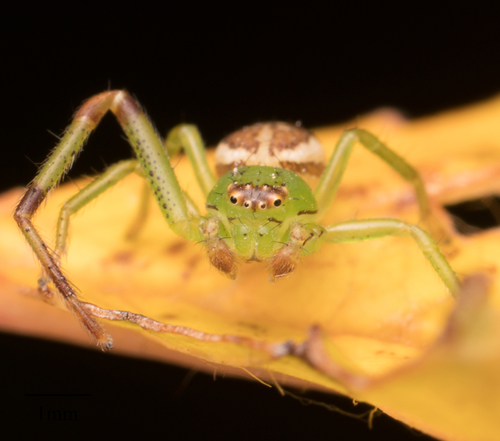
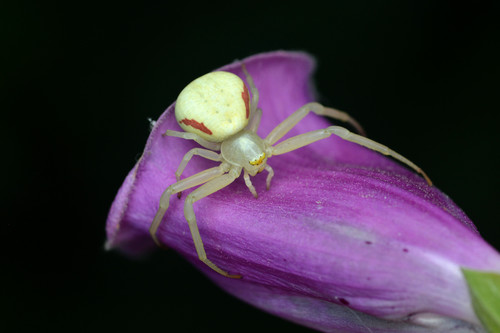
This species, Misumena vatia, has a wide, short, flat, crab-like body. It can walk sideways, as well as forward and backward. Out of its eight legs, the first two pairs are the longest. These legs are usually held open, as the spider uses them to capture prey. Misumena vatia is harmless to humans: its fangs are not strong enough to pierce human skin, and its venom is too weak to harm larger animals. Misumena vatia has two rows of eyes. The eyes in the anterior row are equally spaced and curved backward, while the eyes in the second row vary in appearance between individual spiders, and can be more or less curved than the anterior row. The area surrounding the eyes is narrower at the front than it is at the back. This spider’s hair is erect, and can be either filiform or rod-shaped. The legs do not have spines, with the exception of the underside of the tibia and metatarsus on the first two pairs of legs. The appearance of the clypeus and the structure of the cephalothorax can be used to distinguish the genus Misumena within its subfamily. Misumena vatia is only found in North America and Europe; other species of crab spiders occur worldwide. The species prefers a temperate climate and generally lives in forest biomes. Misumena vatia is terrestrial, and can be found on a number of plants and flowers. In North America these include milkweed and goldenrod, as well as trillium, white fleabane (Erigeron strigosus), ox-eye daisy (Chrysanthemum leucanthemum), red clover (Trifolium pratense) and buttercups (Ranunculus acris). Female Misumena vatia do not travel more than a few yards (meters) from their feeding location. They are attracted by the fragrance of flowers, though other visual and tactile cues also help them select a territory. Their survival depends on choosing a small area with flowering plants that will attract prey. Males are highly mobile and may travel long distances to search for mates. Spiderlings can also travel great distances via ballooning if the area around their nest lacks resources, though this behavior is risky, as there is no guarantee that they will successfully find a new territory. Sex ratios for Misumena vatia range from 1.5 females per male when spiderlings hatch to 2.5–5.1 females per male when individuals reach adulthood. Because males must spend a substantial amount of time searching for females, they face greater environmental danger, which reduces their overall population numbers. Males cannot mate multiple times in quick succession, and require a two-day break between matings. In natural conditions, Misumena vatia produces only one brood per generation. Females are capable of producing an additional brood if artificially induced.