About Missulena occatoria Walckenaer, 1805
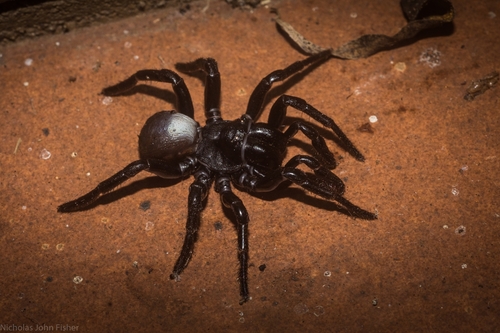
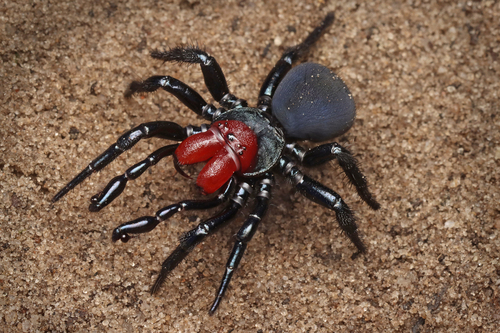
Missulena occatoria, commonly called the red-headed mouse spider, is a spider species native to Australia. It can be found across a range of habitats from open forest to desert shrubland. It is the most widely distributed species in the Missulena genus, found across all of mainland Australia, though it occurs mainly west of the Great Dividing Range. This wide distribution is possible because its spiderlings disperse through wind movement, a behavior called ballooning. Ballooning dispersal is normally seen only in araneomorph spiders; mygalomorph spiders most commonly disperse by walking. While the venom of Missulena spiders may be very toxic, few recorded cases have resulted in serious envenomation. Most recorded bites have only caused minor effects, and antivenom developed for Australian funnel-web spiders has been proven effective for treating bites from this species. Red-headed mouse spiders dig burrows that can reach up to 55 centimeters deep, and these burrows have two trapdoors. Females are approximately 35 millimeters long, with a stout body and short legs. Their bodies are mostly dark brown to black, though their jaws sometimes have a red tinge. Males are smaller, at approximately 15 millimeters long, and have longer, thinner legs than females. Males have bright red heads and jaws, and their abdomens range in color from gunmetal blue to black.