About Mirafra javanica Horsfield, 1821
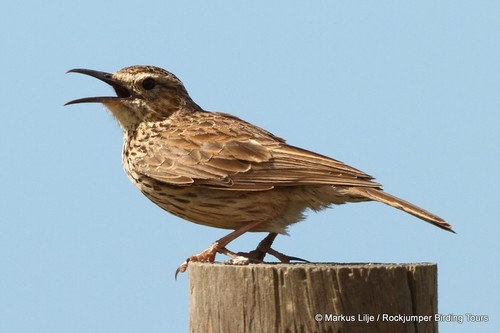
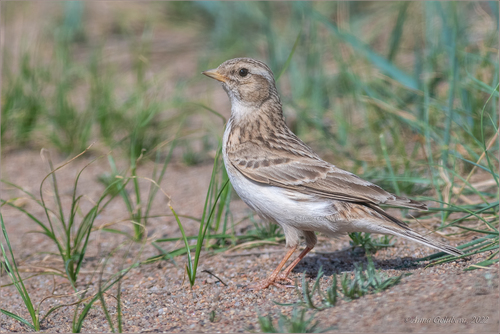
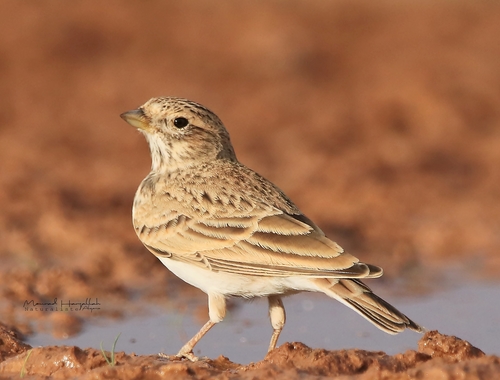
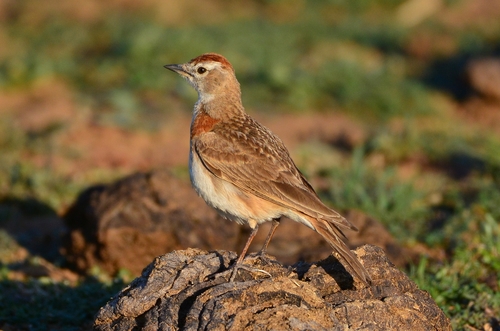
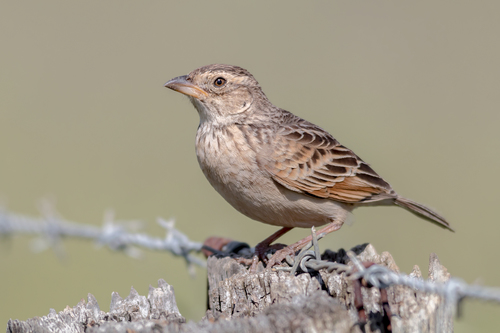
Mirafra javanica, commonly known as the singing bush lark, is a small, thickset bird with a large head, a short sparrow-like bill, and a small crest that is only visible when erected. The dorsal surface of its plumage can be brown, reddish, or sandy, with darker streaks running down the center of each feather. It has a mottled or streaked breast, a pale buff eyebrow, pale underparts, and a brown tail. Adult singing bush larks have near-black upperparts and crown marked with coarse buff to russet streaking. Juveniles have similar coloration to adults, but the crown and upperparts show a neat scaled pattern from narrow white fringes on each feather. Nestlings are covered in dense natal down, and have distinctive contrasting dark spots on their tongue and mouth. The average body measurements for the species are: wing length 61–81 mm, tail length 40–56 mm, bill length 12–16 mm, and body weight 18–25 grams.
The wings of the singing bush lark are short and rounded, with a distinct rufous panel. The innermost secondary feather is vestigial. Of the ten primary feathers, the tenth primary (p10) is very short but not vestigial. Primary feather molt proceeds outward, starting at the first primary (p1); tail and body molt occurs during the early stages of primary molt, or just before primary molt begins.
The singing bush lark has an extremely large range, with an estimated global extent of occurrence of 10,000,000 km². In Australia, it occurs from the Eyre Peninsula in South Australia, through Victoria, New South Wales, Queensland, and the Northern Territory, and across Western Australia to Shark Bay. It is a summer migrant to south-eastern continental Australia, and is a vagrant to the island of Tasmania. In Australia, this species inhabits chenopod shrublands, both native and exotic grasslands in temperate and tropical regions, coastal heathlands, dunes, and mudflats. It also occupies modified open habitats including cropland and pastureland. It is found less commonly on playing fields, golf courses, road verges, salt marshes, and other types of shrubland or heathland, and is rarely found in treed habitats.