About Mirabilis nyctaginea (Michx.) Mac Mill.
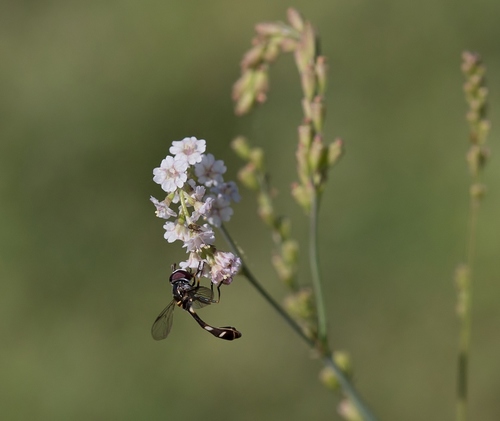
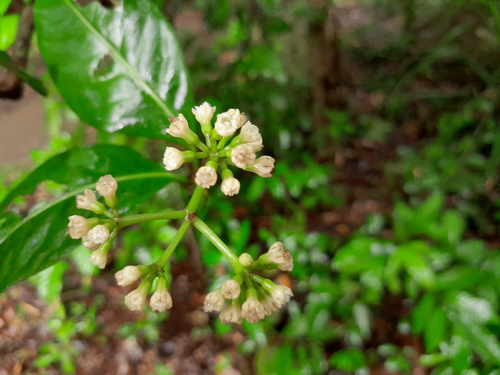
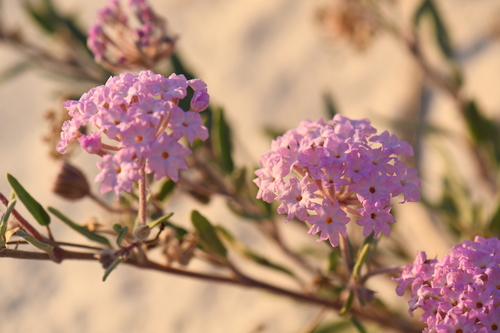
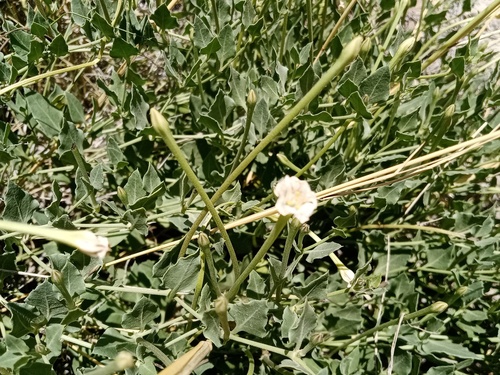
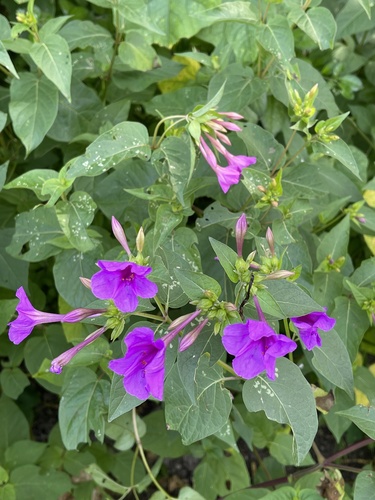
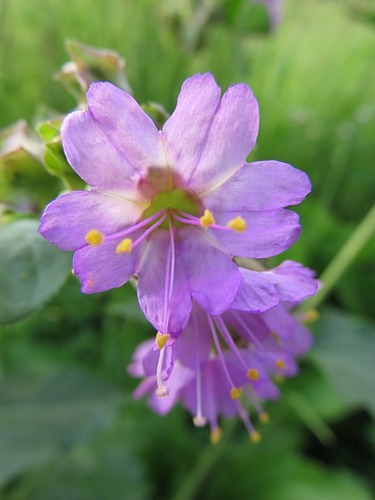
Mirabilis nyctaginea (Michx.) Mac Mill. is a species of flowering plant in the four o'clock family, with several common names including wild four o'clock, heartleaf four o'clock, and heartleaf umbrella wort. This plant is native to the central region of North America, and it grows as an introduced species in other areas, including parts of Europe. Its exact native range is unclear, and it often behaves as a weed across its entire range, spreading easily into disturbed habitats. It is a perennial herb that ranges from hairy to hairless, growing erect to a maximum height of over one meter. Leaves are arranged oppositely, mostly on the lower two-thirds of the plant, below the upper forkings of the stem. Each thin green leaf has an oval or heart-shaped blade that can grow up to 10 centimeters long. Flowers grow in the leaf axils of the upper branches. A cluster of 3 to 5 flowers blooms within a bell-shaped involucre made of five partially fused bracts. Each five-lobed, funnel-shaped flower is about 1 centimeter wide, and ranges in color from magenta or pink to nearly white. Flowers open for only a few hours before dropping, leaving the shaggy-haired developing fruits in the drying, papery cup formed by the bracts. The plant produces a thick, fleshy taproot. Mirabilis nyctaginea is a host plant for the larvae (caterpillars) of several micromoth species: Embola ionis is a stem borer, Neoheliodines cliffordi and N. nyctaginella are leaf skeletonizers, and Aetole tripunctella is a leaf miner. In Skiri Pawnee, this species is called Kactáhkata. Its yellow, sweet root was traditionally used to treat coughs. It was also used in powdered form as a remedy for sore mouth in babies, and brewed into a tea for women after childbirth to reduce abdominal swelling.