About Minucia lunaris (Denis & Schiffermüller), 1775
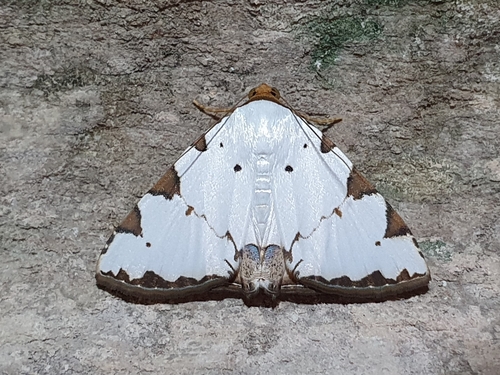
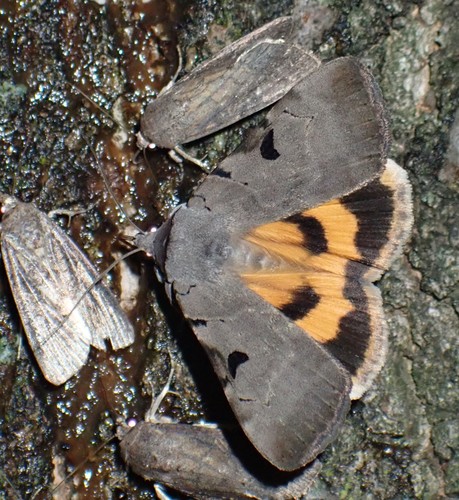
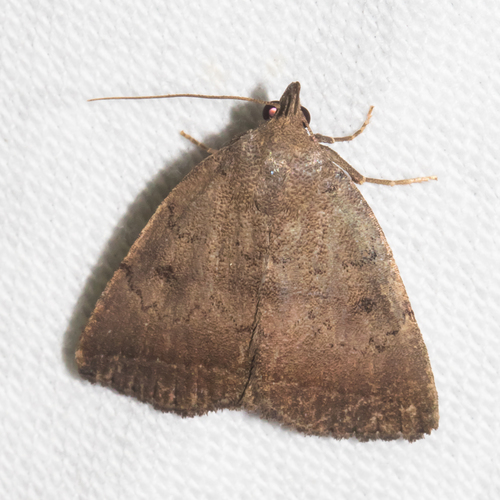
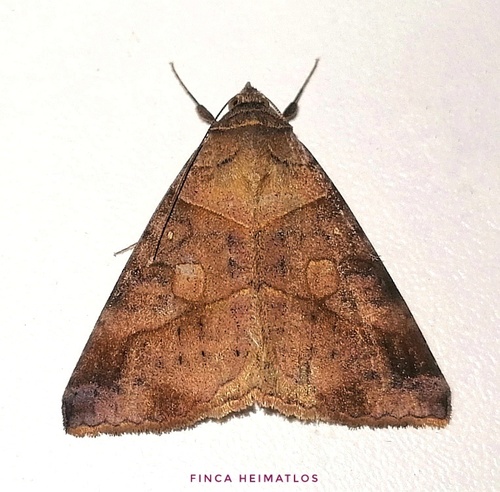
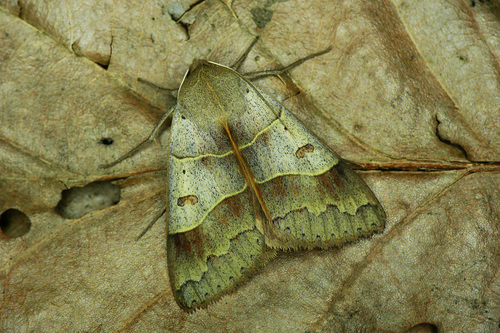
This species is scientifically named Minucia lunaris (Denis & Schiffermüller), 1775, and is also known by the synonym augur Esp. Technical description and variation: The forewing is pale ash grey, faintly dusted with dark, with a slight ochreous tinge. It is always darker in females, which have a pale red brown tinge. The inner and outer lines are yellowish; the inner line is nearly straight, slightly bent inwards on the subcostal vein and vein 1, while the outer line is sinuous and approaches the inner line on the inner margin. The orbicular is a brown dot; the reniform is a brownish lunule. Both lines are followed by a brownish shade: the inner line only below its middle, and the outer line throughout its length. The subterminal line is twice indented, with a large rounded projection above each indentation. The terminal area is darker, with a row of black terminal dots. The hindwing is pale brownish, with a faint curved pale median line before a fuscous brown submarginal border. This species varies in coloration. Aberration ab. rufa Oberth. is red brown with markings more or less obsolete; ab. murina Oberth. is mouse colour throughout, and ab. maura Oberth. is blackish fuscous. Aberration ab. olivescens ab. nov., from Cintra, Portugal, has the whole wing tinged with greenish, and a glossy abdomen. Subspecies inconspicua nov. from Lambessa, North Africa, is a smaller form, generally with slight and inconspicuous markings: dull grey in males, and somewhat pink-tinged in females. The larva is brown. The dorsal line is moniliform. The subdorsal line is broad and dark, enclosing pale spots, with three dark lines beneath it. The spiracular line is pale, sometimes yellowish. Segment 5 has two lateral projections; the last two segments have pairs of dorsal points. The head is brown. The wingspan is 53–61 mm. Distribution: The lunar double-stripe is found in Central and Southern Europe, North Africa, Asia Minor and Kazakhstan. In Great Britain it is a scarce migrant. Frequent records from Sussex in the 1870s suggest it was once resident there. From 1947, moths, ova and larvae were regularly found in Orlestone Wood, Kent amongst oak coppice. Numbers declined from 1953 and the last record was in 1958. This temporary residence is attributed to wartime coppicing and the consequent abundance of oak stools and fresh foliage.