About Mino dumontii Lesson, 1827
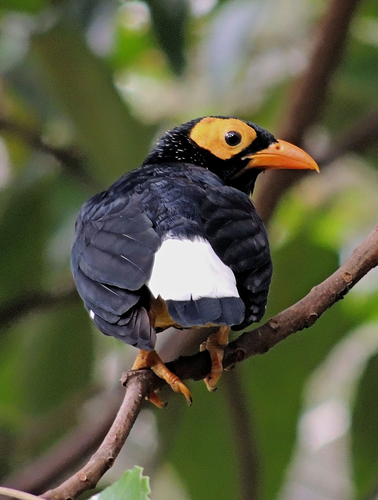
The yellow-faced myna (Mino dumontii Lesson, 1827) reaches a length between 23 and 26 cm (9 and 10 in), and is one of the largest starling species. The head bears short black feathers with bluish-purple gloss on the forehead and at the base of the upper mandible, while most of the head is covered in bare yellowish-orange skin. This bare skin forms a wide patch around and behind the eye, and also includes a bib on the chin and the sides of the throat. The neck, central throat, and mantle are black with purple gloss; the back, wings, breast, and belly are black with green gloss. The rump is white, the lower belly is golden-yellow, and the undertail-coverts are white. The short, squarish tail is black. The iris is typically yellow, but may be brown in some areas of New Guinea. The bill and legs are yellow. This myna is endemic to New Guinea. It occurs on the mainland and its range also extends to many smaller offshore islands. It is common across most of its range up to altitudes of around 800 metres (2,600 ft), and can be found even higher in parts of Papua New Guinea. It is absent from the southeastern coast of the New Guinea mainland. Its typical habitats are rainforests, forest fringes, partially cleared areas, secondary growth, and gallery forests, and it sometimes occurs in savannah areas. Mino dumontii is sometimes observed in small groups, but is more often found in pairs. It occasionally forms larger flocks, and communal roosts holding over two hundred birds have been recorded in tall trees. It is a noisy species that produces a variety of "nasal, growling, and croaking calls with a sometimes human-like conversational quality". It often perches in an elevated position and calls loudly. It has quick wing beats and direct flight, and pairs of birds are often seen flying together; this species may be monogamous and pair for life. It is usually found high in the forest canopy, feeding mainly on berries and fruit, though it also eats small invertebrates, and has been observed catching insects mid-flight. It breeds in tree holes and crevices located well above the ground. Nests are built from twigs, and clutches contain one or two pale blue eggs speckled with grey and rust. Three individuals have been observed carrying nesting material into a single hole, so this species may have some degree of cooperative breeding from extended family members.