About Mimus triurus (Vieillot, 1818)
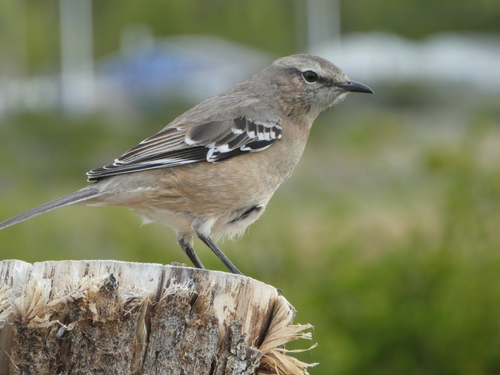
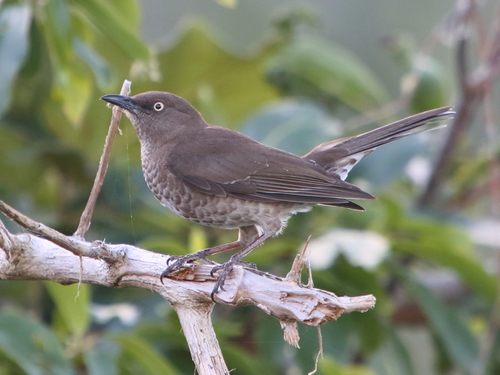
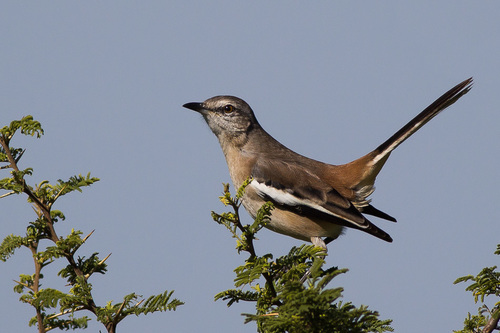
The white-banded mockingbird, Mimus triurus (Vieillot, 1818), is 20 to 23.5 cm (7.9 to 9.3 in) long and weighs 49 to 54 g (1.7 to 1.9 oz). Males are slightly larger than females. Adult white-banded mockingbirds have a grayish crown, a white supercilium, a blackish line running through the eye, and speckled cheeks. Their upperparts are smoky gray that blends to reddish cinnamon on the rump. The central third of the tail is black, and the outer tail feathers are white. A broad white band is visible on the folded wing, while the rest of the wing is blackish. The white markings on the wings and tail are easy to see when the bird is in flight. Adults are mostly whitish on their underparts; their sides and flanks have a cinnamon wash, and their vent area is buffy. Juveniles are similar in appearance to adults, but have a spotted breast and less white in the wing. White-banded mockingbirds breed primarily in central Argentina. During the non-breeding season, the species apparently withdraws from the southernmost part of its breeding range, and can also be found in Bolivia, Brazil, Chile, Paraguay, and Uruguay. It is suspected to breed regularly in all of these additional countries except Brazil and Chile. Vagrants have been recorded in Peru and the Falkland Islands. The white-banded mockingbird lives in a variety of landscapes, including low woodlands, savanna, open brushy country, steppe, and areas around human habitations. It is mostly found below 500 m (1,600 ft) in elevation, but it breeds as high as 2,600 m (8,500 ft) in northern Argentina, and reaches higher elevations as a non-breeder in Bolivia and Chile.