About Mimus polyglottos (Linnaeus, 1758)
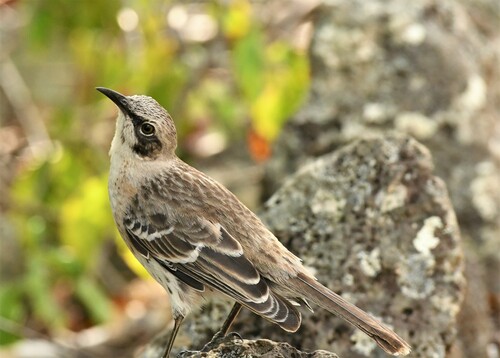
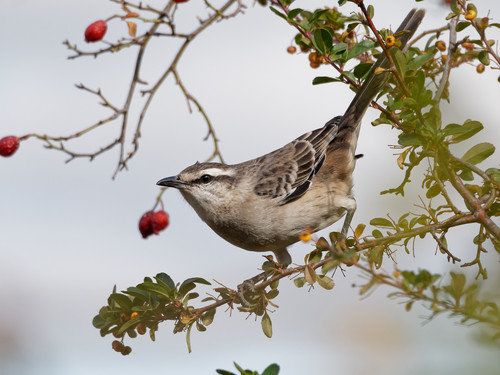
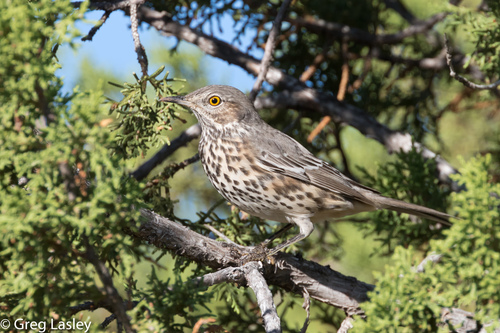
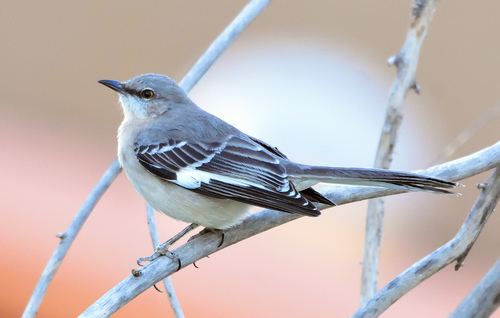
The northern mockingbird (Mimus polyglottos) is a medium-sized mimid with long legs and a long tail. Adult males and females have identical plumage. Adult upperparts are gray, while underparts are white or pale whitish-gray. It has parallel wing bars on the half of the wings connected to a white patch, which creates a distinctive look when the bird is in flight. Its black central tail feathers (rectrices) and characteristic white outer lateral rectrices are also clearly visible during flight. The adult iris is usually light green-yellow or yellow, though rare individuals with orange irises have been recorded. The bill is black, with a brownish-black tone at its base. Juvenile northern mockingbirds can be distinguished by streaks on their back, distinct spots and streaks on their chest, and a gray or grayish-green iris.
Northern mockingbirds have a total length of 20.5 to 28 cm (8.1 to 11.0 inches), and their tail is almost as long as their body. Their wingspan ranges from 31 to 38 cm (12 to 15 inches), and their body mass falls between 40 and 58 g (1.4 to 2.0 oz). Males are typically slightly larger than females. Standard body measurements for the species are: wing chord 10 to 12 cm (3.9 to 4.7 in), tail 10 to 13.4 cm (3.9 to 5.3 in), culmen 1.6 to 1.9 cm (0.63 to 0.75 in), and tarsus 2.9 to 3.4 cm (1.1 to 1.3 in). Wild northern mockingbirds have been recorded living up to 8 years, while captive individuals can live up to 20 years.
The species' breeding range extends from the Maritime provinces of southern Canada, west to southern Oregon, and south through almost all of the continental United States located south of the northern Plains states and Pacific Northwest, the Greater Antilles, and most of Mexico as far as eastern Oaxaca and Veracruz. Most northern mockingbirds are year-round residents within their range, but birds living in the northern part of the range often move south during winter. The species is thought to be at least partially migratory in northern portions of its range, but this migratory behavior is not well understood. Small numbers of northern mockingbirds have been recorded north of the breeding range, as far north as southeastern Alaska. Three individuals have been recorded as transatlantic vagrants in Britain; the most recent of these moved northeast across Britain from Devon via West Sussex to Northumberland between February and May 2021.
In the 19th century, the species' range expanded north into regions including Nova Scotia, Ontario, and Massachusetts, though sightings during this period were sporadic. During the first five decades of the 20th century, new influxes of mockingbirds established populations in Maine, Vermont, Ohio, Iowa, and New York. In western U.S. state of California, the population was originally restricted to Lower Sonoran Desert regions, but by the 1970s the species was resident in most California counties. Humans have introduced northern mockingbirds to several islands, including Hawaii (introduced in the 1920s), Barbados, St. Helena, Socorro Island, the Cayman Islands, and Tahiti; introduction to Bermuda was not successful.
Northern mockingbird habitat varies by location, but the species prefers open areas with sparse vegetation. In eastern parts of its range, it frequently resides in suburban and urban areas such as parks and gardens. It favors mowed lawns with nearby shrubs for shade and nesting. In western regions, desert scrub and chaparral are among its preferred habitats. It prefers short grass when foraging for food. The species does not nest in densely forested areas, and generally stays in the same habitat year-round.