About Mimus longicaudatus Tschudi, 1844
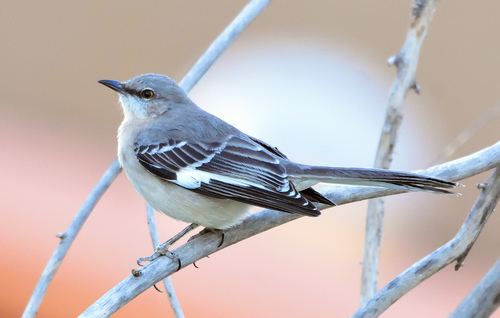
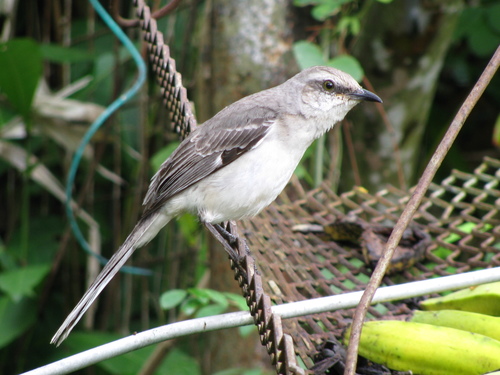
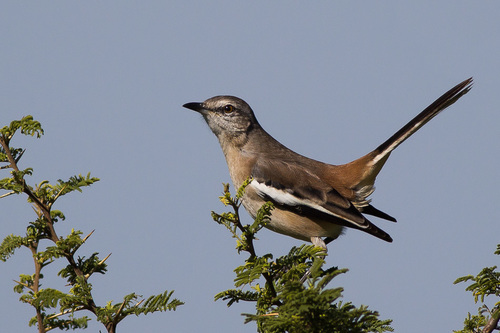
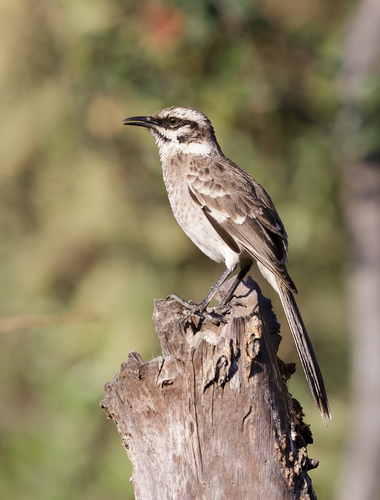
The long-tailed mockingbird (Mimus longicaudatus Tschudi, 1844) measures 27 to 29.5 cm (10.6 to 11.6 in) long and weighs 54 to 79 g (1.9 to 2.8 oz), with an average weight of 66.6 g (2.35 oz). Males are slightly larger than females. Adults of the nominate subspecies have a broad white supercilium, a black stripe through the eye that connects to a black patch on their white cheek. Their crown and upperparts are brownish gray with darker streaks. Their wings and long tail are mostly dusky brown, with white patches that are clearly visible during flight. Their throat, belly, and vent area are white, while their breast and flanks range from buff to dull brown. Juveniles resemble adults but have additional streaks on their chest. The subspecies M. l. albogriseus is smaller and grayer than the nominate subspecies, and has more extensive white coloring on its tail tips. M. l. platensis is similar to M. l. albogriseus, but its size is closer to that of the nominate, and it has a longer bill. M. l. maranonicus is very similar to the nominate and may not actually be a separate subspecies. The long-tailed mockingbird is primarily found along the Pacific coasts of Ecuador and Peru. The nominate subspecies M. l. longicaudatus lives along most of the length of western Peru. M. l. albogriseus occurs in southwestern Ecuador, ranging from central Manabí Province into Peru. M. l. platensis is found only on Isla de la Plata, approximately 30 km (19 mi) off the coast of Manabí. M. l. maranonicus is an exception: it inhabits inland areas along the upper Río Marañón in northwestern Peru. The species lives in coastal desert scrub, arid woodland, hedgerows, and tree groves in agricultural landscapes. It also occurs in gardens and parks. Coastal subspecies range from sea level up to 1,900 m (6,200 ft), while M. l. maranonicus can be found at elevations as high as 2,450 m (8,040 ft).