About Mimus gilvus (Vieillot, 1808)
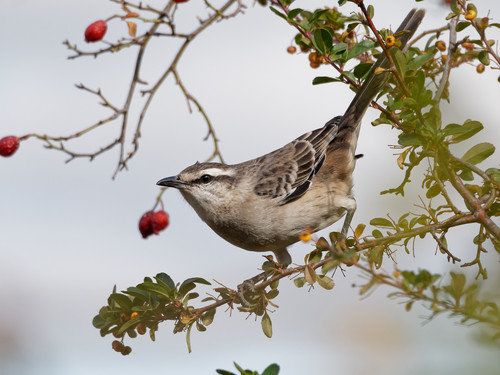
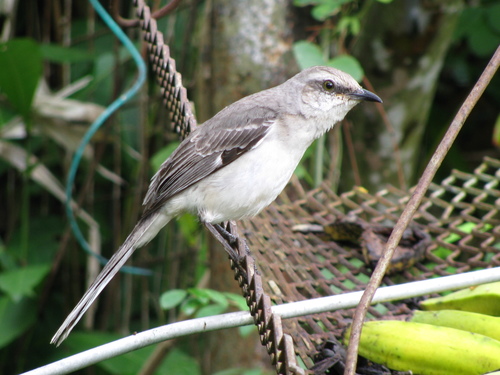
Adult tropical mockingbirds (Mimus gilvus) measure 23 to 25.5 cm (9.1 to 10.0 in) in length. Mean body weight differs greatly between its various subspecies. For adults of the nominate subspecies, the head and upper body are gray, with a whitish supercilium and a dark stripe running through the eye. The underparts are off-white, while the wings are blackish with two white wing bars and white edges on the flight feathers. These birds have a long dark tail with white tips on the feathers, a slim slightly downward-curving black bill, and long dark legs. Juveniles are browner overall, with dusky streaks covering their chest and flanks. Subspecies of Mimus gilvus vary in overall body size, wing length, tail length, plumage color intensity, the extent of pale markings, and eye color. M. g. magnirostris is the largest subspecies and has a noticeably heavier bill than all other subspecies; M. g. tolimensis is also larger than the nominate subspecies. Below is the distribution of each recognized subspecies of the tropical mockingbird: M. g. grac occurs from southern Mexico south to Honduras and El Salvador; M. g. leucophaeus is found on the Yucatán Peninsula, Cozumel, and other offshore islands; M. g. antillarum inhabits the Lesser Antilles from Antigua southward; M. g. tobagensis lives in Trinidad and Tobago; M. g. rostratus occupies southern Caribbean islands from Aruba east to Blanquilla; M. g. melanopterus is distributed across northern and northeastern Colombia, Venezuela, Guyana, and Roraima state in Brazil; M. g. gilvus is found in Suriname and French Guiana; M. g. tolimensis ranges from western and central Colombia south to extreme northern Ecuador, and also from El Salvador to Panama; M. g. antelius occurs along coastal northeastern and eastern Brazil, south to Rio de Janeiro state; M. g. magnirostris is restricted to San Andrés Island off eastern Nicaragua. The population of M. g. tolimensis in El Salvador, Nicaragua, Costa Rica, and Panama descends from escaped cage birds that were originally imported from Colombia. The tropical mockingbird is common across most open habitats, including areas surrounding human settlements. Common habitats include scrublands, savannas, parks, and farmlands. It avoids closed forests and mangroves. It occurs from lowlands up to middle elevations: it reaches about 2,500 m (8,200 ft) in Central America and the northern Andes, has been recorded as high as 2,600 m (8,500 ft) in Colombia, and up to 3,100 m (10,200 ft) in northern Ecuador.